

Managing Calories With a Desk Job: What Sitting All Day Actually Costs
A desk job takes movement out of your baseline and puts food within arm's reach for eight hours. Here's what that costs, and where the calories leak.

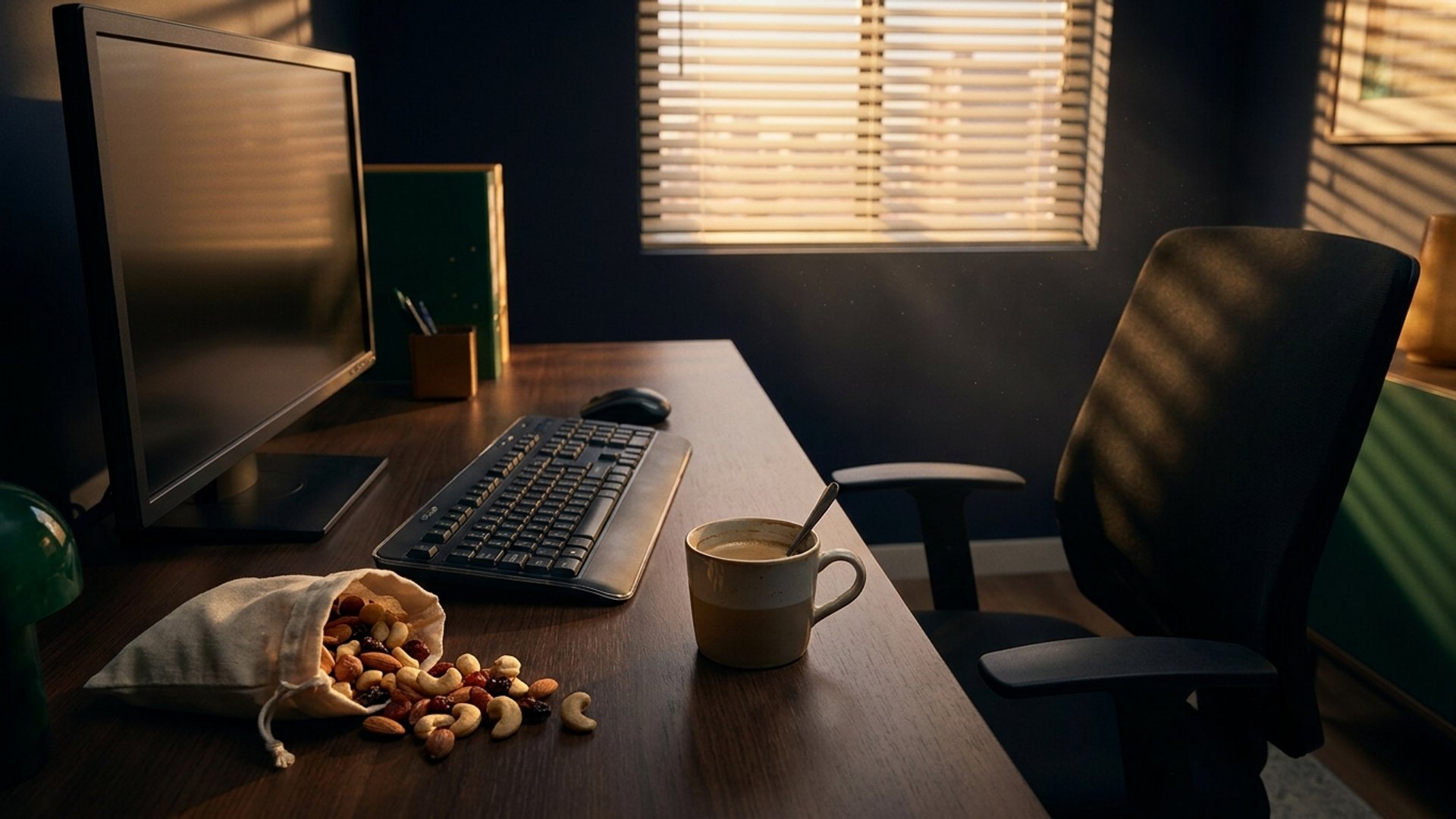
A desk job doesn't burn many calories. Everyone knows that part. The less obvious part is that desk job calories go wrong in two places, and the one people spend money on is the smaller of the two by a wide margin.
Buying a standing desk addresses the energy expenditure side, which is worth about fifty calories a day. The other side is that a chair puts food within arm's reach for eight straight hours while you look at something else.
What sitting takes out of your baseline
The clearest measurements here come from a Mayo Clinic group that spent years instrumenting people rather than surveying them.
In one 2005 study, ten lean and ten mildly obese sedentary volunteers wore sensors that recorded posture and movement every half second for ten days. The obese participants were seated, on average, two hours longer per day. The authors calculated that adopting the movement pattern of the lean group would have burned roughly 350 extra calories a day.
The stubborn part came next. Posture allocation didn't change when the obese participants lost weight, and it didn't change when the lean participants gained it. Whatever decides how much a person fidgets and paces, it isn't current body weight.
That category of movement has a name: non-exercise activity thermogenesis, or NEAT. It covers everything physical you do that isn't deliberate exercise. A 2006 review from the same group put the spread between individuals at up to 2,000 calories a day.
The reason it matters for weight rather than just for step counts showed up in an overfeeding experiment published in 1999. Sixteen non-obese volunteers were fed 1,000 calories a day above maintenance for eight weeks. Two thirds of the rise in their total daily energy expenditure came from NEAT, and how much each person's NEAT went up predicted a tenfold difference in how much fat they stored.
None of that is about job titles. What it shows is how much of a daily total gets decided by movement nobody counts as exercise, which is precisely the category a desk removes. We went through the mechanism in more detail in NEAT: the calories you burn without trying.
The standing desk buys less than it sells
This one has been measured properly. A 2018 systematic review and meta-analysis pooled 46 studies covering 1,184 participants and compared energy expenditure standing against energy expenditure sitting.
The difference was 0.15 calories per minute, with a confidence interval of 0.12 to 0.17. Swap six hours of sitting for standing every day and a 65 kg person burns an extra 54 calories.
Fifty-four calories a day is under half a granola bar. If you stand for six hours and eat one extra biscuit because you're tired of standing, you're behind.
That isn't an argument against standing desks. It's an argument against treating one as a weight loss purchase. The Cochrane review of workplace sitting interventions found sit-stand desks cut sitting time at work by about 100 minutes per workday in the first three months, dropping to 57 minutes at follow-ups between three and twelve months. Both estimates were graded low-quality evidence. Treadmill and cycling desks had unclear or inconsistent effects on sitting time at all.
So the desk does what it says: you sit less. It just doesn't move the calorie number much, and the trials that measured sitting rather than weight are the honest place to look.
The drawer, not the chair
Here is the other half, and it gets far less attention than the furniture.
At a desk you eat by handful and by hour rather than by portion and by meal. These are per Calvin's own food pages:
| Desk snack | Portion | Calories |
|---|---|---|
| Almonds | 1 oz, about 23 (28 g) | 164 |
| Trail mix | 1/4 cup (38 g) | 175 |
| Trail mix | 1 cup (150 g) | 693 |
| Potato chips | small bag, about 15 chips (28 g) | 153 |
| Potato chips | large bag (227 g) | 1,237 |
| Granola bar | 1 bar (25 g) | 118 |
| Pretzels | 1 oz, about 10 twists (28 g) | 109 |
The trail mix rows are the whole problem in miniature. A quarter cup is a snack. A cup, which is what a bag on the desk turns into over an afternoon, is most of a meal. Our trail mix vs almonds comparison goes through why two things that look interchangeable in the same drawer aren't, and the potato chips page has the same spread between the small bag and the big one.
Then there's the eating-while-working part, which has been studied directly. A meta-analysis of 24 experiments in the American Journal of Clinical Nutrition found that eating while distracted produced a moderate increase in how much people ate at the time, and a larger increase in how much they ate later in the day. A separate finding in the same paper is the one that should worry anyone with an open bag beside a keyboard: removing visual information about how much had already been eaten increased intake at that meal.
Under-reporting compounds it. The famous demonstration is a 1992 New England Journal of Medicine study of a small group of people with a history of what they described as diet resistance. Measured against their actual energy expenditure over fourteen days, they under-reported their intake by an average of 47 percent and over-reported their physical activity by 51 percent. That was ten subjects selected for a specific problem, so it isn't a population estimate. It's a demonstration that a person can be sincere and still be several hundred calories out, and grazing at a desk is the exact scenario where the memory fails.
What a movement break is worth
The walking calorie calculator will give you a number for your own weight, but the shape of it is easy to hold in your head. The Compendium of Physical Activities scores moderate-pace level walking at about 3.5 METs, which works out to roughly four calories a minute for a 155 lb adult. A ten-minute walk is about forty calories. Three of those across a workday is somewhere near 120.
Stairs score much higher, from around 4 METs at a slow pace to nearly 9 at a fast one, so two minutes on the stairs is worth about 10 calories for the same person at a slow pace and about 20 at a fast one. Real, but small.
The case for breaks isn't the calorie count. In an Australian population study, the number of breaks people took in their sedentary time was associated with smaller waist circumference, lower BMI, lower triglycerides and lower two-hour glucose, independent of how much total sedentary time and moderate-to-vigorous activity they had. That's cross-sectional, so it shows a pattern rather than a cause, but the pattern held after adjusting for the obvious confounders.
The Cochrane review found something practical alongside it: short breaks of one to two minutes every half hour cut workplace sitting by about 40 minutes a day compared with taking two fifteen-minute breaks. Same total time away from the chair, distributed differently, and only the distributed version moved the number. That came from a single study, so hold it loosely.
Set the target for a sedentary day
Most calculators start from the Mifflin-St Jeor equation and then multiply by an activity factor. The equation itself was derived from measured resting energy expenditure in 498 people. The multipliers stacked on top of it are convention rather than measurement, and they're where desk workers go wrong.
The mistake is picking "lightly active" on the strength of three gym sessions a week. Three hours of training spread across 168 hours doesn't make the other 165 anything other than sedentary, and the wrong multiplier inflates the estimate by two or three hundred calories before you've logged a thing. How to calculate your TDEE covers the arithmetic.
Treat whatever the calculator says as a starting hypothesis. Log honestly for two to three weeks, watch the weight trend rather than the daily number, and adjust the target to what your body did rather than what the equation predicted. Your real maintenance number is the one that reproduces your actual weight over a fortnight.
Sitting less is a health lever, not a weight lever
It's worth separating these, because they get argued as if they're the same claim.
The largest analysis of sitting and mortality pooled 13 studies covering 1,005,791 people. People in the most active quartile who sat more than eight hours a day had no significant increase in mortality risk. People who sat the least but were in the least active quartile still did. The authors put the activity level that appears to eliminate the extra risk from high sitting at roughly 60 to 75 minutes a day of moderate intensity movement.
Two things follow. That's a lot of activity, well past what a lunchtime walk provides. And it's a mortality finding, not a body composition one. Standing up more does not create a calorie deficit. What you eat decides that, and at a desk what you eat is heavily shaped by what's in reach.
The afternoon drink
Worth a short note, because it's the one desk habit people assume is costing them and usually isn't. Black coffee is about 2 calories a cup, and green tea is the same. Our coffee vs green tea comparison is a caffeine and antioxidant question, not a calorie one.
The 3pm oat milk latte is a different item entirely. That's where the calories are, and it's the kind of thing that never gets logged because it registers as a drink rather than as food.
The bottom line
A desk job costs you on the expenditure side, and the loss is real but modest and mostly outside your direct control. It costs you far more on the intake side, where food sits within reach all day and nobody remembers handfuls.
What holds up:
- Movement outside deliberate exercise varies enormously between people and is the category a desk compresses
- Standing instead of sitting is worth about 0.15 calories a minute, or roughly 54 a day over six hours
- Sit-stand desks reliably reduce sitting time, which is a different outcome from reducing weight
- Frequent short breaks beat a couple of long ones for total time out of the chair
- Distracted eating increases intake at the time and later, and hiding how much you've eaten increases it further
- Pick the sedentary activity multiplier, then correct it against two or three weeks of real data
Move the snacks out of arm's reach and log the handful when you take it. The deficit comes from what you eat, not from your chair.
Frequently Asked Questions
Log the Handful, Not Just the Meal
Photograph what you take from the drawer and Calvin does the counting

References
- Levine et al. 2005 - Interindividual variation in posture allocation: possible role in human obesity (Science)
- Levine et al. 2006 - Non-exercise activity thermogenesis: the crouching tiger hidden dragon of societal weight gain (Arterioscler Thromb Vasc Biol)
- Levine, Eberhardt & Jensen 1999 - Role of nonexercise activity thermogenesis in resistance to fat gain in humans (Science)
- Saeidifard et al. 2018 - Differences of energy expenditure while sitting versus standing: A systematic review and meta-analysis (Eur J Prev Cardiol)
- Shrestha et al. 2018 - Workplace interventions for reducing sitting at work (Cochrane Database of Systematic Reviews)
- Robinson et al. 2013 - Eating attentively: a systematic review and meta-analysis of the effect of food intake memory and awareness on eating (Am J Clin Nutr)
- Healy et al. 2008 - Breaks in sedentary time: beneficial associations with metabolic risk (Diabetes Care)
- Ekelund et al. 2016 - Does physical activity attenuate, or even eliminate, the detrimental association of sitting time with mortality? (Lancet)
- Lichtman et al. 1992 - Discrepancy between self-reported and actual caloric intake and exercise in obese subjects (N Engl J Med)
- Ainsworth et al. 2011 - 2011 Compendium of Physical Activities: a second update of codes and MET values (Med Sci Sports Exerc)

Founder & Developer
Ryan is the founder and lead developer of Calvin. With a passion for both technology and health optimization, he built Calvin to solve his own frustrations with manual calorie tracking. He believes that AI can make healthy eating effortless.
Related Articles
Your First Week of Calorie Tracking: What to Expect
The first week of calorie tracking is slow, noisy, and slightly annoying. Here is how long it actually takes, what the scale will do, and what counts as good enough.

Walking for Weight Loss: The Underrated Exercise That Actually Works
Walking doesn't get the respect it deserves for weight loss. Here's the research on why it works, how much you need, and how to make it count.
Should You Eat Back Exercise Calories? When It Makes Sense (And When It Doesn't)
Your watch says you burned 400 calories, should you eat them back? Here's when it makes sense, when it doesn't, and why fitness trackers get it wrong.