

How to Count Calories Without a Food Scale
Learn practical methods for estimating calories without weighing food. Use hand portions, visual references, and smart strategies to track accurately, no scale required.

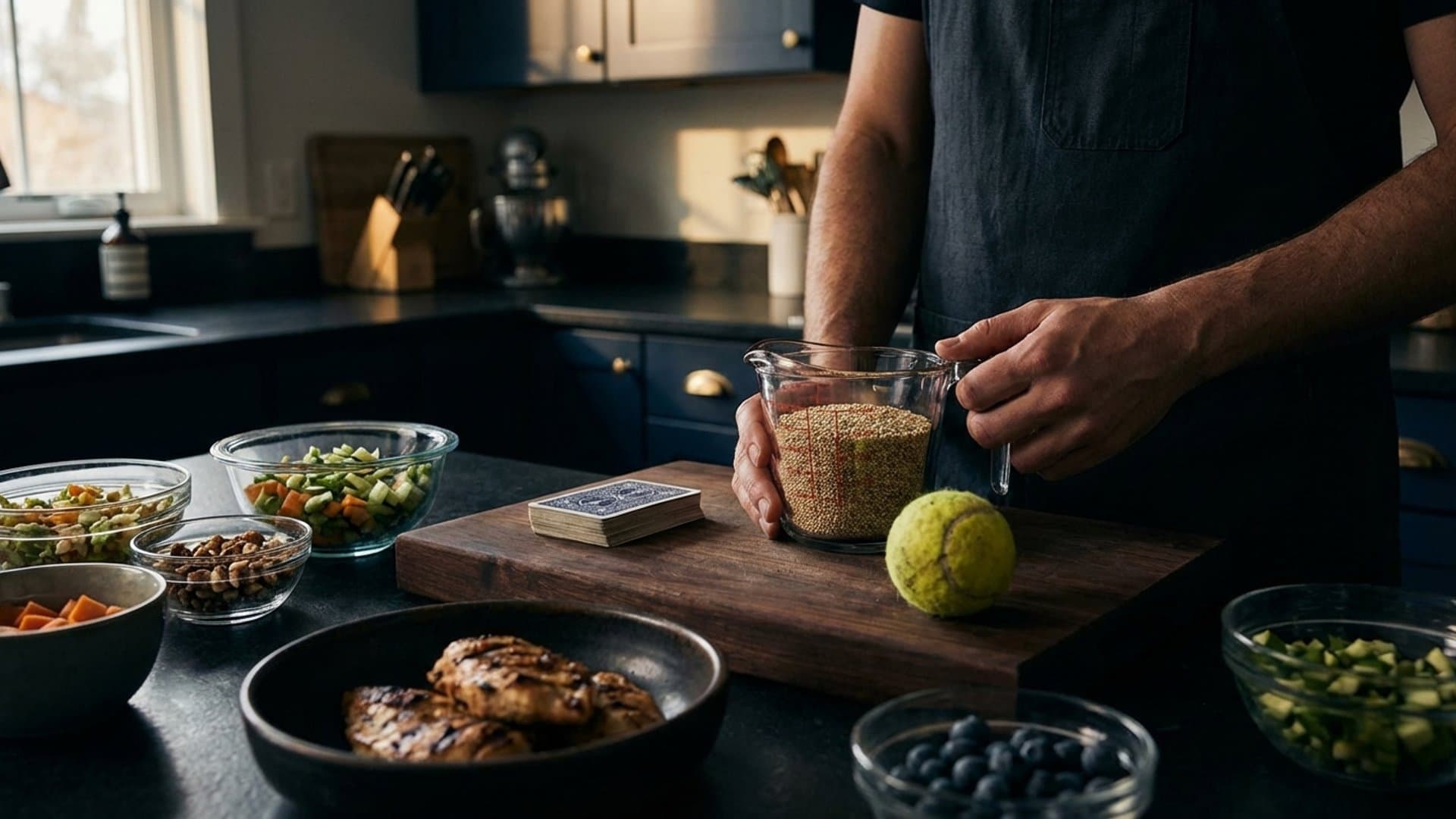
Food scales are great for accuracy, but be honest. You're not bringing one to restaurants, work lunches, or dinner at a friend's house. And you probably don't want to weigh every meal at home either.
You don't have to. With some practical estimation techniques you can track calories well enough using just your hands and eyes.
The hand method: your built-in measuring tool
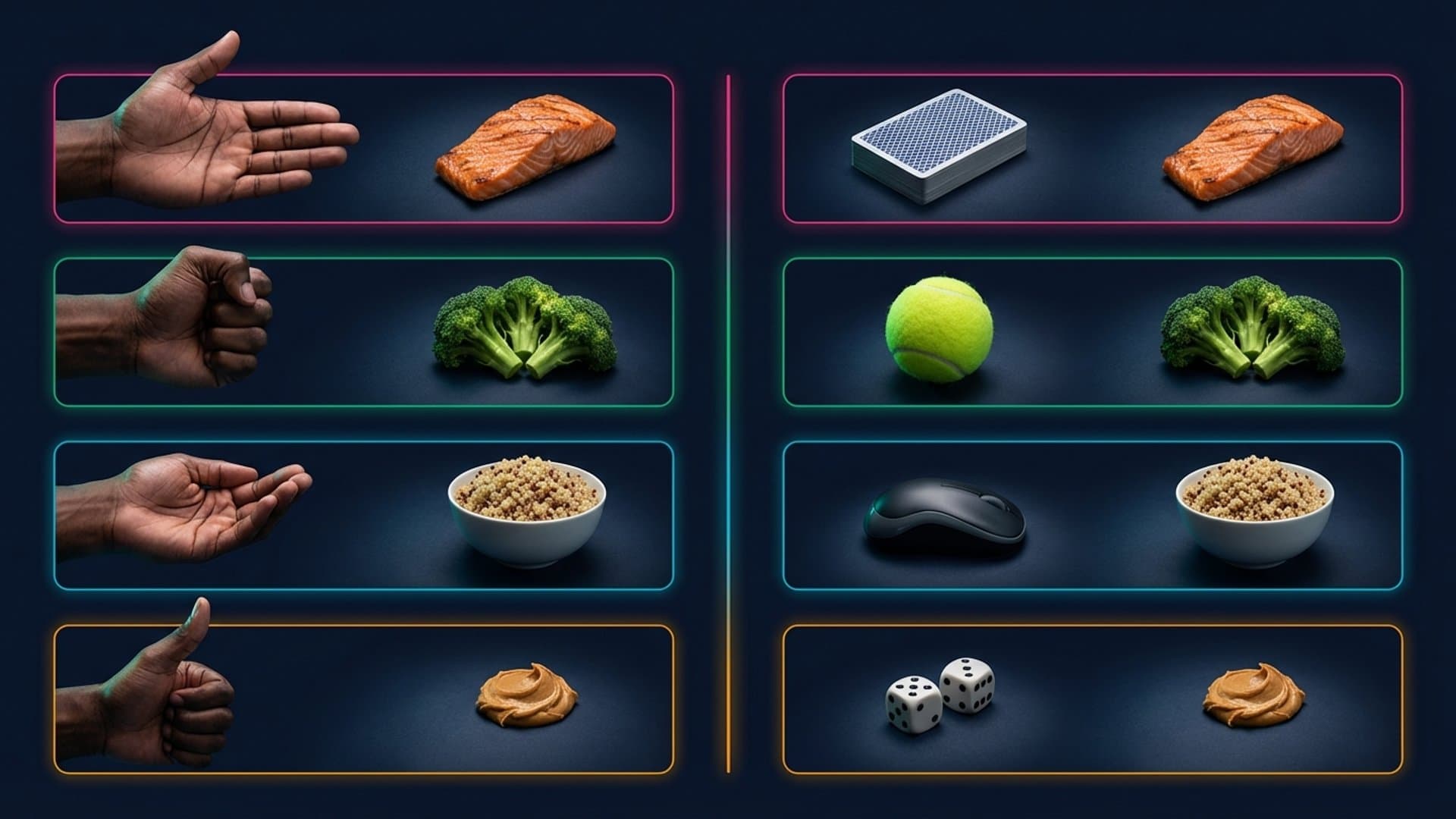
Your hands are always with you, and their size scales roughly with your body.
Protein portions
| Hand Reference | Portion Size | Works For |
|---|---|---|
| Palm (no fingers) | 3-4 oz / 85-115g | Meat, fish, poultry |
| Palm thickness too | ~20-30g protein | Same |
| Two palms | 6-8 oz / 170-225g | Larger protein servings |
Calorie estimates by protein type (per palm):
- Chicken breast: 130-150 cal
- Salmon: 150-180 cal
- Beef (lean): 180-220 cal
- Beef (fatty): 250-300 cal
- Pork chop: 150-180 cal
- Tofu: 80-100 cal
Carbohydrate portions
| Hand Reference | Portion Size | Works For |
|---|---|---|
| Cupped hand | 1/2 cup / 120ml | Rice, pasta, potatoes |
| Fist | 1 cup / 240ml | Larger carb portions |
| Two cupped hands | 1 cup / 240ml | Cereal, popcorn |
Calorie estimates (per cupped hand/half cup):
- Cooked rice: 100-120 cal
- Cooked pasta: 100-110 cal
- Mashed potatoes: 90-100 cal
- Oatmeal (cooked): 75 cal
Fat portions
| Hand Reference | Portion Size | Works For |
|---|---|---|
| Thumb tip | 1 tsp / 5ml | Oils, butter |
| Whole thumb | 1 tbsp / 15ml | Nut butter, mayo |
| Two thumbs | 2 tbsp / 30ml | Larger fat servings |
Calorie estimates (per thumb):
- Olive oil: 40 cal (tip), 120 cal (whole)
- Butter: 35 cal (tip), 100 cal (whole)
- Mayonnaise: 31 cal (tip), 94 cal (whole)
- Peanut butter: 30 cal (tip), 95 cal (whole)
- Cream cheese: 25 cal (tip), 75 cal (whole)
Vegetable portions
| Hand Reference | Portion Size | Works For |
|---|---|---|
| Fist | 1 cup | Raw leafy greens |
| Cupped hand | 1/2 cup | Cooked vegetables |
| Two fists | 2 cups | Salad base |
Most non-starchy vegetables are 25-50 calories per fist, so estimates here matter less.
The hand method is naturally personalized. Larger people have larger hands and typically need more food. It isn't perfect, but it builds awareness fast.
Visual comparisons: common objects
When hands don't feel intuitive, compare to everyday objects.
Protein comparisons
| Object | Portion | Example |
|---|---|---|
| Deck of cards | 3 oz meat | Chicken breast, steak |
| Checkbook | 3 oz fish | Salmon fillet |
| iPhone | 4 oz meat | Larger portion |
| Two decks | 6 oz meat | Restaurant portion |
Carb and grain comparisons
| Object | Portion | Example |
|---|---|---|
| Tennis ball | 1/2 cup | Rice, pasta, ice cream |
| Baseball | 1 cup | Cereal, fruit |
| Hockey puck | 1/2 cup dense | Mashed potatoes |
| Computer mouse | Small potato | Baked potato |
Fat and cheese comparisons
| Object | Portion | Example |
|---|---|---|
| Dice (1) | 1 tsp | Butter, oil |
| Poker chip | 1 oz cheese | Sliced cheese |
| 4 dice | 1 oz cheese | Cubed cheese |
| Golf ball | 2 tbsp | Nut butter, hummus |
| Shot glass | 1 oz nuts | Almonds, cashews |
The plate method: simplest approach
If individual portions feel too fiddly, use the plate method.
Divide your plate
Half the plate is non-starchy vegetables (minimal calories). A quarter is protein (palm-sized). A quarter is carbs or starches (cupped hand). Plus a small addition of healthy fats (thumb-sized).
Quick calorie estimate by plate
| Plate Setup | Approximate Total |
|---|---|
| Veggie-heavy, lean protein, small carb | 400-500 cal |
| Balanced plate as described | 500-650 cal |
| Protein-heavy with moderate carbs | 550-700 cal |
| Carb-heavy (pasta dish, rice bowl) | 600-800 cal |
Practical strategies for common situations
At home
Calibrate your tools: occasionally use measuring cups or a scale to sanity-check your estimates. Learn what a "cupped hand" of rice actually looks like in your usual bowl.
Use consistent dishes: eating from the same bowls and plates helps you build intuition. You'll know "filled to the pattern line" is roughly a cup.
Portion before plating: serve food from containers onto your plate rather than eating from the pot or bag. Easier to estimate when you can see the full portion.
At restaurants
Estimate by comparison: a restaurant chicken breast is typically 6-8 oz (two palms), not 3-4 oz. Pasta servings are often 2-3 cups, not one.
The half rule: restaurant portions are roughly 1.5-2x normal servings. If the menu says "grilled chicken breast," assume double what you'd serve at home.
Ask for size cues: "Is that an 8-ounce steak?" Servers often know, and the menu sometimes specifies.
Use our Portion Visualizer to practice estimating common foodsAt work
Pre-portion snacks: transfer snacks to small containers at home where you can measure, then eat from those containers at work.
Know your containers: learn what your lunch containers hold. If your salad container is 4 cups, you can estimate how much you filled it.
Common office foods:
- Standard bagel: 250-350 cal
- Slice of office birthday cake: 300-400 cal
- Conference room cookies: 50-100 cal each
- Coffee with cream and sugar: 50-80 cal
At social events
Scan before serving: look at every option before plating. Easier to estimate when you're intentional rather than grazing.
Use a 20-30% buffer: when in doubt, add 20-30%. Social foods are usually richer than home cooking.
Focus on the big items: don't stress about the garnish. Get the main protein, starch, and fatty additions roughly right.
Improving your estimation skills
The calibration method
Once a week:
- Estimate a portion by eye
- Weigh or measure it
- Note the difference
- Adjust your mental model
After a few weeks, your estimates improve a lot.
The photo method
Take a photo of your meal before eating. Later, you can compare it to reference images, use AI-powered analysis for quick estimates, or review patterns in your portion sizes.
Skip the Guesswork
Calvin's AI analyzes your food photos instantly, just snap and track

Learn common weights
Memorize a few baseline weights for foods you eat often.
| Food | Common Portion | Calories |
|---|---|---|
| Egg | 1 large (50g) | 70 |
| Banana | 1 medium (120g) | 105 |
| Apple | 1 medium (180g) | 95 |
| Bread | 1 slice (30g) | 80 |
| Chicken breast | 4 oz (115g) | 140 |
| Salmon | 4 oz (115g) | 160 |
| Rice (cooked) | 1 cup (160g) | 200 |
| Pasta (cooked) | 1 cup (140g) | 220 |
When estimation falls short
Some foods are harder to estimate than others. Be more careful with these.
High-density foods
- Nuts and nut butters: a small overestimate adds a lot of calories
- Oils and butter: easy to use more than you think
- Cheese: density makes portions deceiving
- Dried fruit: much more calorie-dense than fresh
Restaurant dishes
- Anything sauced or fried: hidden fats are hard to see
- Salads: dressings, cheese, nuts add up fast
- "Healthy" options: often as caloric as the regular dishes
Liquid calories
- Smoothies: size and ingredients vary wildly (a single tablespoon of chia seeds adds 58 calories)
- Coffee drinks: anywhere from 5 to 500+ calories
- Alcohol: pours are inconsistent and cocktails are unpredictable
For high-stakes situations (like reaching a specific goal by a deadline), consider using a scale at home and being extra conservative with restaurant estimates. The margin for error is smaller.
The bottom line
You don't need perfect accuracy to succeed with calorie tracking. Studies show that consistent tracking with moderate error beats not tracking at all.
The goal isn't perfection. It's building awareness of what you're eating, learning relative portion sizes, and making informed choices. Your intuition improves with practice.
Start with the hand method, calibrate occasionally, and don't let the lack of a scale stop you from tracking. Good-enough estimates logged consistently will beat perfect numbers logged sporadically.
Frequently Asked Questions
Make Tracking Effortless
Calvin uses AI to estimate calories from photos, no measuring required
References

Founder & Developer
Ryan is the founder and lead developer of Calvin. With a passion for both technology and health optimization, he built Calvin to solve his own frustrations with manual calorie tracking. He believes that AI can make healthy eating effortless.
Related Articles
How to Estimate Portions When You Can't Measure
Master visual portion estimation for any situation. From restaurants to buffets to dinner parties, these techniques help you track calories accurately anywhere.
How to Count Calories at a Buffet or Potluck Without Weighing Anything
How to count calories at a buffet or potluck when nothing has a label. What the portion research says, which dishes actually cost you, and how to log the plate afterward.
Your First Week of Calorie Tracking: What to Expect
The first week of calorie tracking is slow, noisy, and slightly annoying. Here is how long it actually takes, what the scale will do, and what counts as good enough.