

Do You Need 8 Glasses of Water a Day?
The 8 glasses of water a day rule has no study behind it. Here's where it came from, what official intake guidelines say, and how to tell what you need.

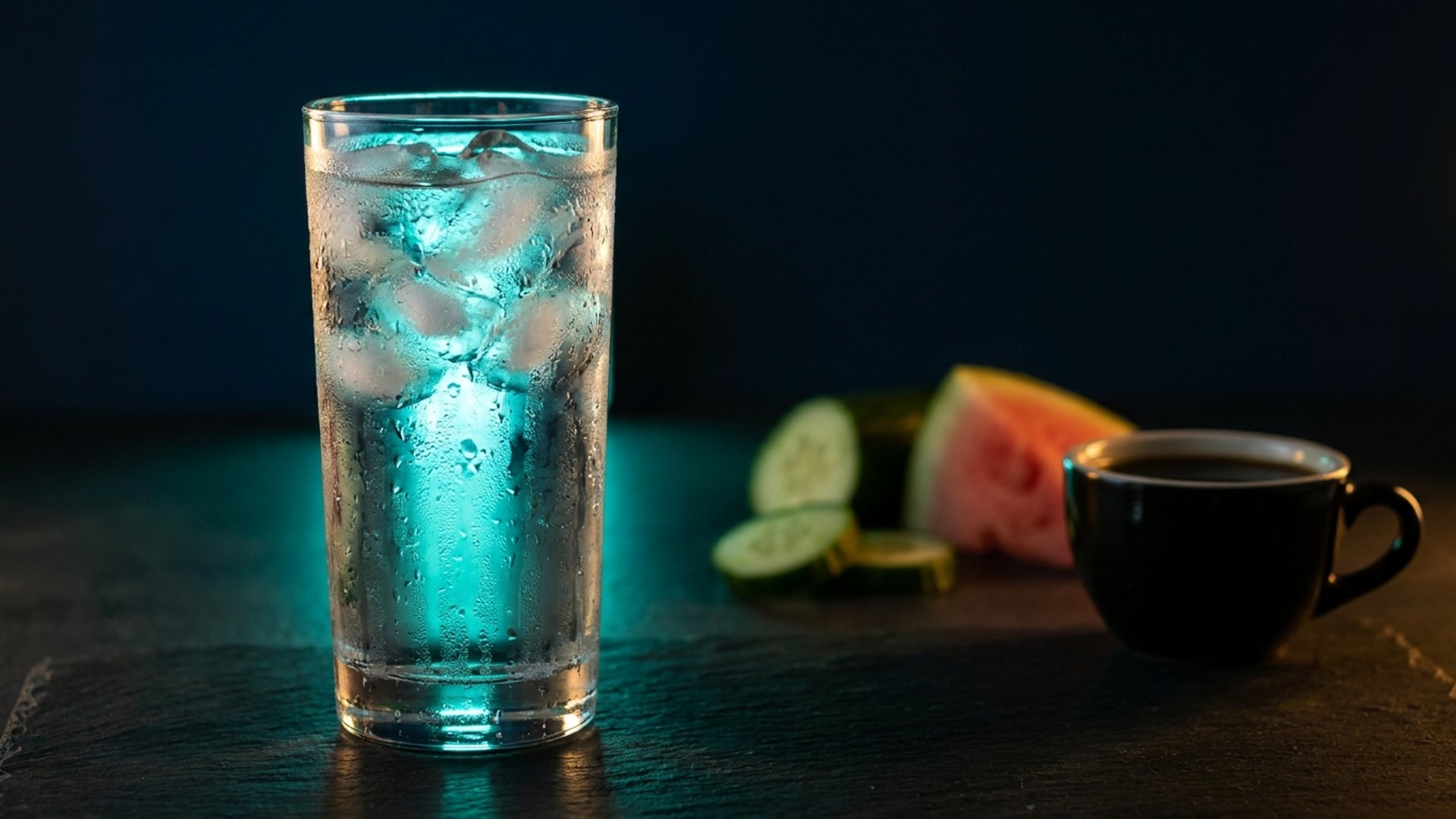
Somewhere along the way, 8 glasses of water a day became the number everyone knows. It's printed on bottles and built into apps, and it turns up in the back of your head every time you finish a coffee and feel vaguely like it doesn't count. The strange part is that nobody has been able to find the study it came from.
A Dartmouth physiologist went looking in 2002 and came back with nothing.
The search that turned up empty
Heinz Valtin, a kidney physiologist, ran a formal review of the evidence for what he called "8 x 8": eight 8-ounce glasses a day, with the usual footnote that coffee and alcohol don't count. He searched the electronic databases and the older literature that predates them, then consulted researchers who specialize in thirst and drinking behavior.
He found no scientific studies supporting it, not even weak ones.
His best guess at where the number came from was a Food and Nutrition Board recommendation of roughly 1 milliliter of water per calorie of food, whose very next sentence, that most of that quantity is already contained in prepared foods, appears to have been dropped in the retelling.
What he found instead was the opposite: surveys of food and fluid intake in thousands of adults showing that the people drinking less than 8 x 8 were healthy and not overtly ill. He also concluded that caffeinated drinks can be counted toward the daily total, and that the body's osmoregulatory system is precise enough to handle the job without a quota.
Valtin was careful about the scope of that conclusion. It applies to healthy adults in a temperate climate living a mostly sedentary life. Hard physical work, hot weather, illness, and several medical conditions all change the answer, and he said so explicitly.
"No evidence for 8 x 8" is not the same as "drink less." It means the specific number was never derived from anything. The real guidelines land higher, and they count things 8 x 8 tells you to ignore.
What the official numbers actually say
Two bodies have published reference values for water intake, and they agree on the important part.
| Body | Adult men | Adult women | What it counts |
|---|---|---|---|
| Institute of Medicine (US, 2004) | 3.7 L/day | 2.7 L/day | Total water: all drinks plus water in food |
| EFSA (EU, 2010) | 2.5 L/day | 2.0 L/day | Total water: all drinks plus water in food |
Eight 8-ounce glasses is about 1.9 liters. Both sets of numbers are higher than that, and both are also much easier to reach, because "total water" means everything. Your coffee counts. So does soup, and so does the water in an orange. The IOM estimated that roughly 20% of total water intake comes from food and the other 80% from beverages, caffeinated ones included.
These figures are Adequate Intakes, not requirements. An AI is set near the observed median intake of a healthy population, which means it describes what people who show no signs of inadequacy already consume. It is a description first and a target second. Falling below it does not mean you are dehydrated.
Your number is not a fixed number
The largest measurement of human water use to date came out in 2022. Researchers tracked water turnover in 5,604 people from 23 countries, ranging from 8 days old to 96 years old, using deuterium as a tracer rather than asking anyone to keep a log.
Turnover varied enormously, and the things that predicted it were the things you'd guess: age, body size and composition, physical activity, athletic status, pregnancy, air temperature and humidity, altitude, latitude, and how developed the country was. People in lower human development index countries had higher turnover than people in high-HDI countries.
One caveat that gets lost when this study is summarized. Water turnover is not the same as the amount of water you need to drink. It includes water in food and water your body produces from metabolism, and much of it is recycled internally rather than replaced by the glass. The study's own framing is that intake requirements largely reflect turnover, not that turnover is a drinking target.
A single national number cannot be right for both a 55 kg office worker in Seattle and a 95 kg roofer in Phoenix. Anyone selling you one number for both is not measuring anything.
Food and coffee count
This is where the 8 x 8 framing does actual damage, because it teaches people to discount two large sources of water.
Food
Around a fifth of total water intake arrives on a plate. Produce is mostly water by weight, which is also why it takes up so much room in your stomach for so few calories. From our own food data:
| Food | Calories per 100 g |
|---|---|
| Celery | 14 |
| Cucumber | 15 |
| Lettuce (iceberg) | 17 |
| Tomato | 18 |
| Watermelon | 30 |
A large salad and a wedge of melon do real hydration work. They are also the backbone of high volume eating, where the goal is filling your stomach without filling your calorie budget. The two goals happen to overlap.
Coffee
The "coffee dehydrates you" claim has been tested directly. In a counterbalanced crossover trial, 50 habitual male coffee drinkers spent three days on 4 x 200 mL of coffee (4 mg/kg caffeine) and three days on water, with food, fluid, and activity controlled. Total body water was measured with deuterium oxide, alongside urine volume, specific gravity, osmolality, creatinine, and blood markers.
Nothing separated the two conditions. Total body water was 51.5 kg on coffee and 51.4 kg on water. Twenty-four hour urine volume was 2,409 mL versus 2,428 mL. Only sodium excretion differed, and it was slightly higher on coffee.
That study used men who already drank 3 to 6 cups a day at a moderate dose, so it isn't a license to treat six espressos as a hydration strategy if you never drink coffee. But for the habitual coffee drinker, the cup adds to the day's water total instead of subtracting from it.
Not all hydrating drinks are calorie-free. Water and black coffee are effectively free; juice and soda are not.
| Drink | Calories per 8 oz cup |
|---|---|
| Water | 0 |
| Black coffee | 2 |
| Green tea | 2 |
| Coconut water | 46 |
| Soda | 101 |
| Orange juice | 112 |
If you're tracking, the difference between coconut water and orange juice matters more than either one's hydration credentials. Our coconut water vs orange juice comparison has the full breakdown.
How to tell whether you're drinking enough
For a healthy adult, thirst is a good system. It runs on plasma osmolality and reacts to changes small enough that you never consciously notice them. Valtin's whole argument rests on that precision.
Urine color is the other rough gauge. Pale straw is unremarkable; consistently dark suggests you're behind. It's imperfect: B vitamins turn urine bright yellow regardless of hydration, beets and some medications shift it too, and a first-morning sample is darker by design.
Thirst is less reliable in specific situations:
- Older adults, where the thirst response is blunted even when body water is low
- Hard or prolonged exercise, especially in heat, where sweat losses outrun the signal
- Illness with fever, vomiting, or diarrhea
- Pregnancy and breastfeeding, which raise requirements
- Certain medications and conditions, including a history of kidney stones, where clinicians often set an explicit intake target
That last group is a real exception rather than a hedge. A 2018 review put it plainly in its title: the daily water requirement is elusive, and it has resisted being pinned to a number for decades. If a doctor has given you a target, that target beats anything on this page.
The one place water does move the scale
There is a real, measured weight loss effect, and it has nothing to do with metabolism.
In a 12-week trial, 48 adults aged 55 to 75 with a BMI between 25 and 40 followed a reduced-calorie diet. Half of them drank 500 mL of water before each meal. The water group lost about 2 kg more than the group on the diet alone.
The mechanism is stomach volume and meal-time fullness, not a metabolic boost. We went through the thermogenesis version of this claim in detail in does drinking cold water burn extra calories, and the short version is that the temperature effect is tiny while the pre-meal effect is not.
The other lever is substitution. One 12 oz soda a day is about 150 calories. Replace it with water and that's roughly 1,000 calories a week gone with no change to what you eat.
Water weight is not fat
Drinking more water will move the scale in the short term, and drinking less will move it the other way. Neither is fat.
Glycogen holds water at roughly 3 to 4 grams per gram stored, sodium intake shifts fluid distribution within hours, and hormonal cycles do their own thing. Day-to-day swings of a kilo or two are normal and mean almost nothing on their own. Why your weight fluctuates day to day covers the mechanics.
If you sharply increase water intake this week, expect the scale to wobble. Judge the trend over two weeks, not the number tomorrow morning.
Can you drink too much?
Yes, though it takes effort. Drinking more than the kidneys can excrete dilutes blood sodium, which is called hyponatremia, and severe cases can be fatal.
There have been three International Exercise-Associated Hyponatremia Consensus Development Conferences, the most recent in 2015, convened largely because endurance athletes were being hospitalized and occasionally dying after over-drinking during events. The guidance that came out of that work leans on drinking according to thirst rather than to a fixed schedule.
For a sedentary adult sipping through the day, this is not a practical concern. For anyone forcing down a gallon on a schedule during a long hot event, it is.
The bottom line
The 8 glasses of water a day rule is not evidence. It's a number that escaped into the wild and stuck because it's memorable.
What holds up:
- Reference intakes (2.0 to 3.7 L/day depending on body and sex) are higher than 8 x 8 but count food and every drink
- Individual needs vary by body size, activity, climate, and health, and the variation is large
- Coffee and tea count toward your total for habitual drinkers
- Thirst is a reliable guide for most healthy adults, with real exceptions
- Water before meals helps with weight loss, through fullness rather than metabolism
- Calories in drinks are worth tracking even when hydration isn't
Drink when you're thirsty, and drink more when it's hot or you're working hard. Stop counting glasses.
Frequently Asked Questions
Track What You Drink, Not Just What You Eat
Calvin logs beverages alongside meals so the calories in your cup stop hiding

References
- Valtin 2002 - Drink at least eight glasses of water a day. Really? Is there scientific evidence for 8 x 8? (Am J Physiol Regul Integr Comp Physiol)
- Institute of Medicine 2004 - Dietary Reference Intakes for Water, Potassium, Sodium, Chloride, and Sulfate (National Academies Press)
- EFSA Panel on Dietetic Products, Nutrition and Allergies 2010 - Scientific Opinion on Dietary Reference Values for water (EFSA Journal)
- Yamada et al. 2022 - Variation in human water turnover associated with environmental and lifestyle factors (Science)
- Armstrong & Johnson 2018 - Water Intake, Water Balance, and the Elusive Daily Water Requirement (Nutrients)
- Killer et al. 2014 - No evidence of dehydration with moderate daily coffee intake (PLoS One)

Founder & Developer
Ryan is the founder and lead developer of Calvin. With a passion for both technology and health optimization, he built Calvin to solve his own frustrations with manual calorie tracking. He believes that AI can make healthy eating effortless.
Related Articles
Does Drinking Cold Water Burn Extra Calories?
Does cold water burn calories? Your body does spend energy warming it, but the amount is small and the research is messier than the internet suggests. Here's the real math.
NEAT: The Calories You Burn Without Trying
NEAT calories, non-exercise activity thermogenesis, can vary by 2,000 a day between people. Here's how it works and how to add 200-500 daily without exercising.
Starvation Mode: Myth vs. Reality (What Research Actually Shows)
Will eating too little make your body 'hold onto fat'? Here's what the Minnesota Starvation Experiment and modern research reveal about metabolic adaptation.