

Does Drinking Cold Water Burn Extra Calories?
Does cold water burn calories? Your body does spend energy warming it, but the amount is small and the research is messier than the internet suggests. Here's the real math.

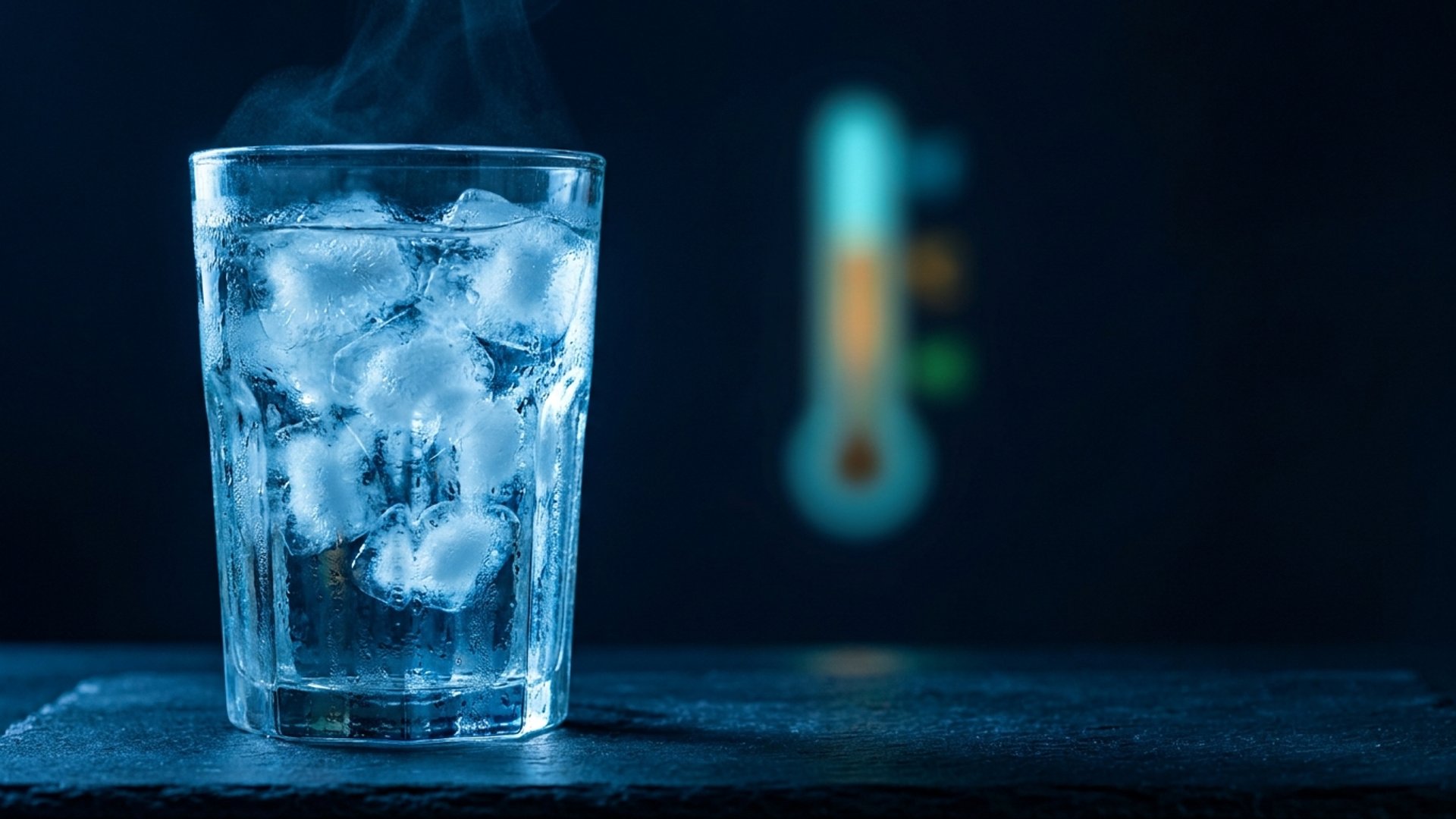
Does cold water burn calories? Technically yes, and the honest version of that answer is much less exciting than the version you've read. Your body holds itself near 37°C. Ice water arrives at 4°C. Something has to close that gap, and closing it costs energy.
The question is how much. The internet has settled on numbers that sound satisfying and mostly aren't sourced. The actual research is older and thinner than the confident blog posts suggest, and it contradicts itself.
Where the claim comes from
Two separate ideas got merged into one piece of folk wisdom.
The first is straightforward thermodynamics. Warming a cold liquid to body temperature requires heat, and if your body is defending its temperature, that heat has to come from metabolism.
The second is a specific 2003 study. Boschmann and colleagues had 14 healthy adults drink 500 mL of water and reported a 30% jump in metabolic rate, a total thermogenic response of about 100 kJ. The paper attributed only about 40% of that to warming the water from 22 to 37°C. The rest they tied to sympathetic nervous system activity, since blocking beta-adrenoreceptors blunted the response.
That second mechanism, a nervous system response to the water itself rather than to its temperature, is the interesting one. It's also the one that has not held up well.
The physics ceiling
Start with what can't be argued about. It takes one calorie of heat, the small kind, to raise one gram of water by one degree Celsius. A food Calorie is a thousand of those.
An 8 ounce glass is about 237 grams of water. Warming it from refrigerator temperature to body temperature means covering roughly 33 degrees:
237 g × 33 °C = 7,821 small calories = about 7.8 food Calories
| Drink | Volume | Starting temp | Ceiling |
|---|---|---|---|
| Glass of ice water | 237 mL (8 oz) | 4 °C | ~8 Calories |
| Large bottle | 500 mL (17 oz) | 4 °C | ~17 Calories |
| Eight glasses over a day | 1,900 mL | 4 °C | ~63 Calories |
| Room temperature glass | 237 mL (8 oz) | 22 °C | ~4 Calories |
That column is a ceiling, not a measurement. It's the maximum possible cost if every bit of the warming is paid for by extra metabolism and nothing offsets it. Real bodies are not that tidy.
The offset matters. You are constantly shedding heat to the room. Absorbing a cold drink can simply reduce how much heat you lose to the air for a while, or let your core temperature dip by a fraction of a degree, rather than triggering any extra burn. Under those conditions the drink costs you nothing metabolically. It just changes where your existing heat goes.
How the thermic effect of food actually worksWhat the measurements found
Three years after the original paper, Brown, Dulloo and Montani published a direct reassessment in the same journal. They tested the osmotic mechanism specifically, comparing distilled water against saline, and found no rise in energy expenditure after either one. Cooling the water to 3°C did produce something, a 4.5% rise over 60 minutes, but that was well below the theoretical energy cost of warming the water to body temperature. They concluded that this casts doubt on water as a thermogenic agent.
Later work has landed in a similar place. Charriere and colleagues gave 27 adults 500 mL of room temperature water and saw resting energy expenditure rise by less than 3% above baseline, which was not significantly different from sham drinking. Small, sometimes indistinguishable from noise, and nothing like the spike the 2003 paper reported.
The one population where the effect looks larger is children with excess weight. Dubnov-Raz and colleagues gave 21 overweight children 10 mL per kg of 4°C water and measured resting energy expenditure up to 25% above baseline, peaking near an hour in and staying elevated for over 40 minutes. That's a different population on a different dose relative to body size, and it's one study. It doesn't transfer cleanly to an adult filling a water bottle at their desk.
When a body of research contains one dramatic early result, a failed replication, and several modest findings, the honest summary is that the effect is small and poorly pinned down. Anyone quoting you a precise per-glass number is quoting the arithmetic above, not a measurement.
Why the number keeps inflating
You will find claims that ice water burns 100 calories a day, or that it's worth a pound a month. The 100 traces back to the 2003 paper's own extrapolation, which projected about 400 kJ a day from two liters. The rest come from taking the physics ceiling, assuming it's fully paid by metabolism, assuming no offset, then multiplying by an aggressive daily volume.
Even the generous version of that stack lands around 60 to 70 calories a day, and only if you drink close to two liters of genuinely cold water and none of the heat is recovered from what you were already shedding. The realistic figure is somewhere between zero and that, and nobody has measured it well enough in free-living adults to give you a confident number.
For scale, 63 calories is about fifteen minutes of easy walking. Our walking calorie calculator will show you the equivalent for your own weight. Nobody is building a diet strategy around fifteen minutes of walking, and this is the optimistic case.
The same math applied to "negative calorie" foodsThe part that does work
Water genuinely helps with weight loss. Just not through the thermostat.
Dennis and colleagues ran a trial in middle-aged and older adults on a reduced-calorie diet, where one group drank 500 mL of water before each meal. Over twelve weeks the water group lost about 2 kg more than the group that didn't. The mechanism there is stomach volume and meal-time satiety, not thermogenesis, and the effect size is larger than anything the temperature argument can offer.
The bigger lever is displacement. Water replaces things that have calories in them. Sparkling water is zero. Using our soda data at about 42 calories per 100 grams, a single 12 ounce can runs roughly 150 calories. Swap two of those a day for water and you've removed around 300 calories, which is several times the absolute ceiling of the ice water effect and doesn't depend on any contested physiology.
| Change | Calories affected per day | How confident should you be |
|---|---|---|
| Drinking your water cold instead of room temperature | 0 to ~60 | Low. Small, contested, possibly offset |
| Water before meals to reduce intake | Varies, often 75 to 200 | Moderate. Supported by trial data |
| Replacing two sodas with water | ~300 | High. It's just arithmetic |
So should you drink it cold
Sure, if you like it cold. There's no downside worth mentioning, and people tend to drink more water when they enjoy the temperature. Drinking more water is the goal, and the temperature is just a preference.
What you should not do is count it. Don't log negative calories for ice water or build a deficit around it, and don't let a hydration habit substitute for the parts of your intake that actually carry weight. If you want to know what your day's numbers need to look like, our TDEE calculator gives you a starting maintenance figure to work against.
The same reasoning applies to cold exposure generally. Cold showers and ice baths get sold as metabolic tools, and so does keeping the thermostat low. The energy cost is real and it is also small relative to what you eat in a day.
The bottom line
Cold water does cost your body energy. The arithmetic puts a glass of ice water at roughly 8 calories, and that figure is a ceiling rather than a measurement, because some of the heat comes out of what you were losing to the room anyway.
The famous 2003 study that launched the claim reported a 30% rise and credited most of it to something other than warming, and a direct follow-up in the same journal failed to reproduce that. Where later studies find an effect at all, it's a few percent of resting expenditure for about an hour.
Drink water because it helps you eat less and because you need it. Drink it cold because you prefer it cold. The calories are a rounding error, and the honest reason to stay hydrated has never been thermodynamics.
Another metabolism claim that doesn't survive the numbersFrequently Asked Questions
Spend Your Attention Where the Calories Are
Calvin makes logging the meals that actually matter fast

References
- Boschmann et al. 2003 - Water-induced thermogenesis (J Clin Endocrinol Metab)
- Brown, Dulloo & Montani 2006 - Water-induced thermogenesis reconsidered: the effects of osmolality and water temperature on energy expenditure after drinking (J Clin Endocrinol Metab)
- Charriere et al. 2015 - Water-induced thermogenesis and fat oxidation: a reassessment (Nutrition & Diabetes)
- Dubnov-Raz et al. 2011 - Influence of water drinking on resting energy expenditure in overweight children (Int J Obes)
- Dennis et al. 2010 - Water consumption increases weight loss during a hypocaloric diet intervention (Obesity)

Founder & Developer
Ryan is the founder and lead developer of Calvin. With a passion for both technology and health optimization, he built Calvin to solve his own frustrations with manual calorie tracking. He believes that AI can make healthy eating effortless.
Related Articles
Starvation Mode: Myth vs. Reality (What Research Actually Shows)
Will eating too little make your body 'hold onto fat'? Here's what the Minnesota Starvation Experiment and modern research reveal about metabolic adaptation.
Can You 'Boost' Your Metabolism? The Truth
Green tea, spicy foods, meal timing, do any metabolism 'boosters' actually work? A science-based look at what really affects your metabolic rate and what's just marketing.
Does Eating Late at Night Cause Weight Gain? The Science
Separating fact from fiction on late-night eating and weight gain. What the research actually shows about meal timing, metabolism, and your waistline.