

How to Track Homemade Recipes and Meals
Step-by-step guide to calculating and tracking calories in homemade recipes. Learn how to log home-cooked meals accurately without overcomplicating your process.

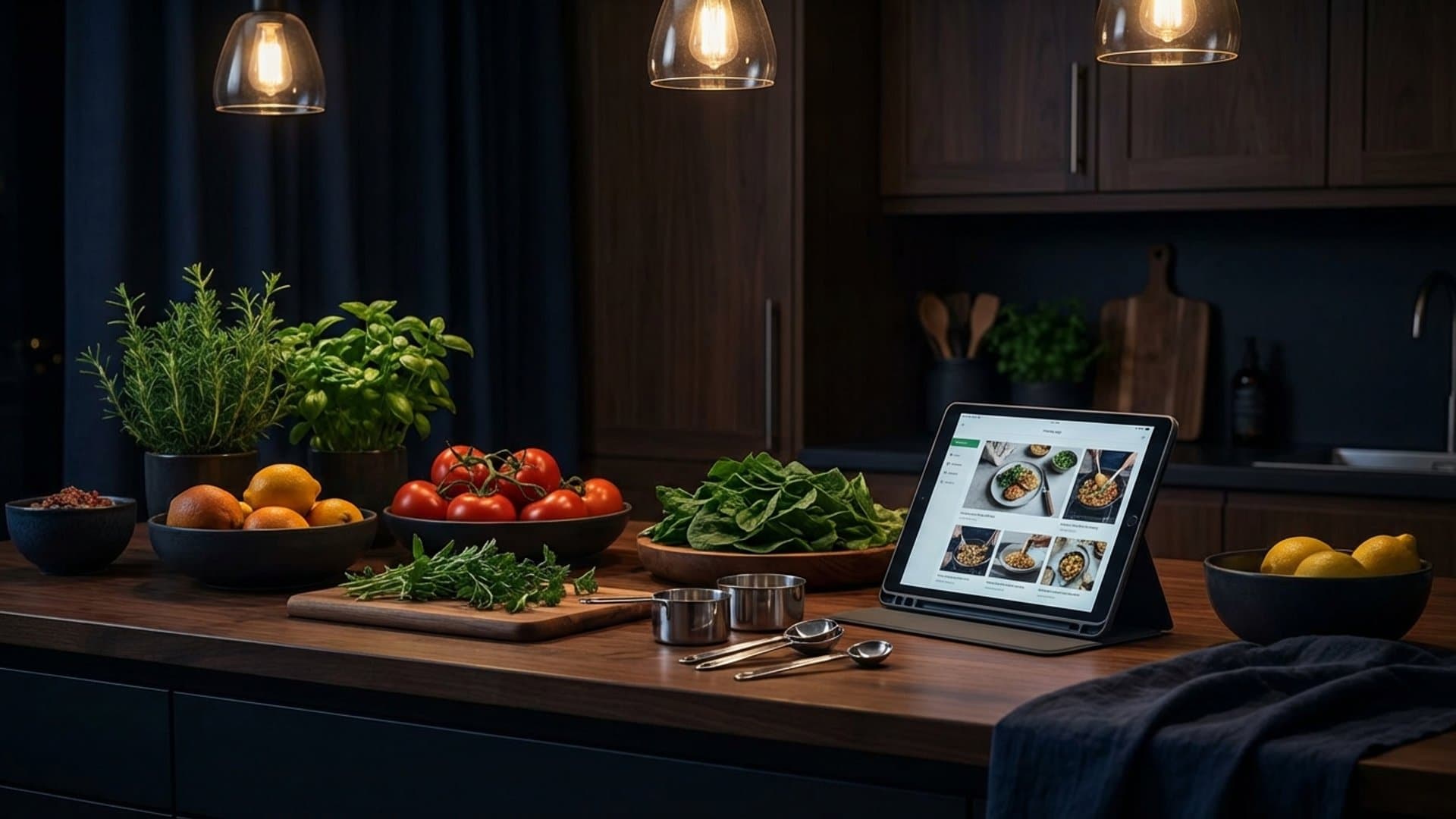
Home-cooked meals are usually healthier and lower-calorie than restaurant food, but they come with a tracking challenge. How do you log a pot of chili or a stir-fry when no nutrition label exists?
Simpler than you'd think. Here's the full guide to tracking homemade recipes accurately.
The basic formula
Tracking homemade recipes is three steps:
- Add up the calories of all ingredients
- Divide by the number of servings
- Log your portion
That's it. Everything else is technique for making this easier and more accurate.
Method 1: The Quick Ingredient Tally
For simple meals you make regularly, a quick ingredient list works well.
Example: Chicken Stir-Fry (4 servings)
| Ingredient | Amount | Calories |
|---|---|---|
| Chicken breast | 1 lb (450g) | 500 |
| Broccoli | 2 cups | 50 |
| Bell pepper | 1 large | 35 |
| Soy sauce | 3 tbsp | 30 |
| Sesame oil | 2 tbsp | 240 |
| Garlic | 3 cloves | 15 |
| Ginger | 1 tbsp | 5 |
| Rice (cooked) | 3 cups | 600 |
| TOTAL | 1,475 |
Per serving (4): 369 calories
Notice that sesame oil, just 2 tablespoons, accounts for 16% of the total calories. Cooking fats are the most commonly underestimated ingredient in home cooking.
Tips for quick tallying
- Round ingredients to easy numbers (1 lb, 1 cup, 1 tbsp)
- Don't sweat garlic, herbs, and spices. They're typically less than 20 calories total
- Focus on the big four: protein, carbs, fats, and any sauces
- Keep a note on your phone for recipes you make often
Method 2: The Recipe Builder Approach
For recipes you make repeatedly, build a saved recipe once and reuse it.
Step 1: List All Ingredients
Be thorough the first time. Include:
- Main ingredients (protein, vegetables, grains)
- Cooking fats (oil, butter)
- Sauces and condiments
- Garnishes (cheese, cream, nuts)
Step 2: Measure or Estimate Amounts
For maximum accuracy, measure the first time you make the recipe. After that, you'll know your typical portions.
Step 3: Calculate Total Calories
Look up each ingredient in a food database. Add them up.
Step 4: Determine serving size
This is where people often go wrong. Be honest about how many servings the recipe actually makes. If it's a pot of soup and you eat a third, it's 3 servings. If you and a partner split a casserole evenly, it's 2 servings. If your "4-serving" recipe always feeds you and your family 5 times, it's 5 servings.
Step 5: Save for future use
Most tracking apps let you save custom recipes. Do it once, log with one tap forever.
Use our Recipe Calculator to build and save custom recipes instantlyMethod 3: The Weighing Method (Most Accurate)
For precise tracking, weigh the final dish.
How It Works
- Weigh your empty pot or container
- Add all ingredients (tracking as you go)
- Cook the recipe
- Weigh the full pot
- Calculate total weight (full pot - empty pot)
- Create per-gram calorie value (total calories ÷ total grams)
Example: Homemade Soup
- Empty pot: 1,200g
- Full pot after cooking: 3,700g
- Total soup weight: 2,500g
- Total recipe calories: 1,500 cal
- Calories per 100g: 60 cal
Now you can weigh your portion and know exactly how many calories you're having. A 350g bowl = 210 calories.
The weighing method adds work upfront but gives you the most accurate results. It's especially useful for soups, stews, and sauces where "one serving" is hard to define.
Handling Common Cooking Scenarios
Marinades and Sauces
The absorption question: How much marinade actually gets eaten?
For marinades:
- Grilled/broiled meats: Count 25-50% of marinade calories
- Braised or slow-cooked: Count 75-100% (most gets absorbed)
- Marinades discarded after: Count 15-25%
For sauces you serve with food:
- Measure what you put on your plate, not what's in the pan
Cooking fats
Cooking fats are the biggest source of untracked calories in home cooking. Full stop.
| Cooking Method | Fat Absorption |
|---|---|
| Sautéing | ~80% of oil used stays in food |
| Pan-frying | ~60-70% |
| Deep frying | ~10-15% (but you use a lot) |
| Roasting | ~70-90% |
| Grilling | ~30-50% (some drips off) |
Rule of thumb: Count at least 75% of cooking oil added to the pan for sautéed dishes.
Learn more about commonly underestimated foods and how to track them accuratelyTrimmed Fat and Discards
If you trim visible fat from meat or leave the chicken skin:
- Remove it before weighing the portion you'll eat, or
- Track the lean portion only if you know you'll discard the fat
Recipes that change volume
Some foods shrink during cooking (meat, spinach). Others expand (rice, pasta, oats).
Track raw vs. cooked consistently. Databases have both entries (e.g., "rice, raw" vs. "rice, cooked"). Pick one approach and stick with it. Raw weights are more consistent; cooked weights are more practical.
Building Your Recipe Library
Categories to Cover
Create saved recipes for:
- Breakfast staples (your usual oatmeal, eggs, smoothie)
- Weekly dinners (recipes in your regular rotation)
- Meal prep favorites (batch-cooked items)
- Snacks and sides (homemade dips, roasted vegetables)
What to Include in Saved Recipes
- All ingredients with amounts
- Total servings (be realistic)
- Notes on variations (e.g., "add 100 cal if using coconut milk")
- Cooking method if it affects calories
Updating recipes
When you change a recipe, create a new version rather than overwriting. Note the date so you know which one to use. Minor variations don't need separate entries.
The "Close Enough" Approach
You don't need perfect precision for every home-cooked meal. Here's when to simplify:
For vegetable-heavy dishes
Non-starchy vegetables are low-calorie enough that estimates work fine. Focus your precision on proteins and fats.
For regular rotation meals
Once you've calculated a recipe accurately, small ingredient variations don't matter much. Use your saved recipe.
For "everything but the kitchen sink" meals
Leftover stir-fries and clean-out-the-fridge dishes are hard to replicate exactly. Estimate the main components and log it as a custom meal.
The 80/20 rule: Accurately tracking the protein, carbs, and fats gets you 80% of the accuracy. Obsessing over exact vegetable weights adds minimal value.
Common Recipe Tracking Mistakes
Mistake 1: Forgetting the Cooking Fat
A tablespoon of olive oil adds 120 calories. If you use "a glug" every time you cook, you might be missing 200-400 calories daily.
Fix: Measure your cooking oil for a week to learn your habits.
Mistake 2: Unrealistic Serving Counts
That "4-serving recipe" that you eat in two sittings? It's a 2-serving recipe for tracking purposes.
Fix: Be honest. Count the servings you actually eat.
Mistake 3: Ignoring Toppings and Garnishes
Cheese, sour cream, croutons, nuts, chia seeds (58 calories per tablespoon), and dressings added at the table are still calories.
Fix: Track toppings separately or include typical amounts in your recipe.
Mistake 4: Not Accounting for Evaporation
Soups and stews lose water weight during cooking. The calories concentrate into less volume.
Fix: Weigh the final product or count servings based on how you actually divide the finished dish.
Mistake 5: Tracking the Recipe, Not Your Portion
A recipe might make 4 servings, but if you serve yourself a bigger bowl, you're eating 1.5 servings.
Fix: Know what "one serving" looks like in your dishes, or weigh your portions.
Meal Prep: Track Once, Log All Week
Meal prepping makes recipe tracking easier. You calculate once and log the same entry all week.
The Meal Prep Tracking Workflow
- Calculate the full batch using any method above
- Divide into containers (equal portions are easiest)
- Weigh one container if you want precision
- Save as a recipe with portions matching your containers
- Log the same recipe each time you eat a container
Meal prep tips for easier tracking
- Use identical containers so portions are consistent
- Keep components separate when possible (sauce on the side)
- Label with the date and calories if it helps you remember
- Prep in realistic portions that match your calorie goals
When to Use Database Recipes vs. Custom
Use Database Recipes When:
- Making a common dish (spaghetti bolognese, chicken curry)
- Looking for a quick estimate
- The recipe is standardized
Create Custom Recipes When:
- You have specific ingredient amounts
- You make the dish regularly
- The database version doesn't match your recipe
- Precision matters for your goals
Frequently Asked Questions
Skip the Math
Calvin's recipe feature calculates nutrition automatically from your ingredients

References

Founder & Developer
Ryan is the founder and lead developer of Calvin. With a passion for both technology and health optimization, he built Calvin to solve his own frustrations with manual calorie tracking. He believes that AI can make healthy eating effortless.
Related Articles
Counting Calories on a Budget: Cheap Food That's Easy to Track
Counting calories on a budget doesn't mean worse accuracy. Here's what the price research shows, and which cheap staples are easiest to weigh and log correctly.
Tracking Fast Food Calories: How to Use the Published Numbers
Fast food is the easiest meal to track accurately, because the numbers are already published. Here's how to read them, where they go wrong, and what to log.

How to Track Alcohol Calories (Without Ruining Your Social Life)
Practical guide to tracking alcohol calories while maintaining a social life. Learn drink calorie counts, planning strategies, and how to make room in your budget.