

Are All Calories Created Equal? The Nuance Behind the Saying
Are all calories created equal? For energy balance, mostly yes. For digestion, hunger, and body composition, no. Here's what the research actually says.

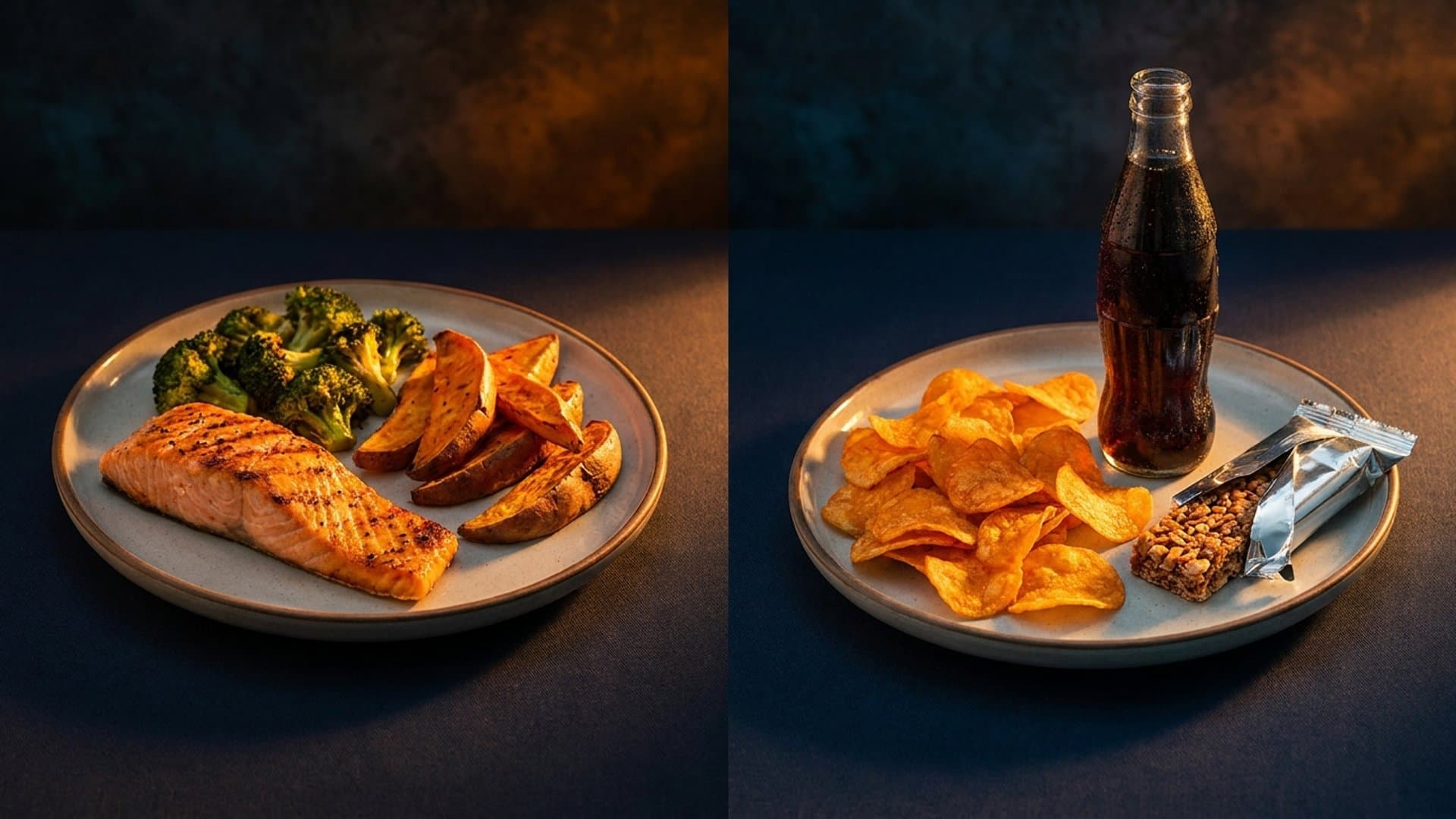
"A calorie is a calorie." It's the rallying cry of every energy-balance purist, and the rebuttal to every wellness influencer hawking magic foods. So are all calories created equal? In a bomb calorimeter, yes. Inside a human body, sort of, but not really. The label number is an estimate, the digestion cost varies by macronutrient, and the food matrix changes how much actually gets absorbed. Here's what the research shows once you go past the slogan.
Where the Saying Came From
The phrase traces back to Wilbur Atwater, a 19th-century USDA chemist who burned foods in a calorimeter and assigned the now-familiar values: 4 kcal/g for protein, 4 kcal/g for carbs, 9 kcal/g for fat, 7 kcal/g for alcohol. Those Atwater factors sit behind every nutrition label in your kitchen.
The energy-balance argument that came out of this work is hard to dispute at the system level. If you eat fewer calories than you burn over a long enough window, you lose weight. The first law of thermodynamics doesn't care whether the calories came from broccoli or birthday cake.
Energy balance still wins at the macro level. The nuance isn't whether a calorie deficit causes fat loss (it does), but how different foods affect the inputs and outputs of that equation: how much you absorb, how much it costs to digest, and how hungry you feel an hour later.
The slogan starts breaking down once you ask three follow-up questions:
- How much of the labeled calories does your body actually absorb?
- How much energy does your body spend digesting them?
- How does the food affect what you eat next?
The answers to those questions are why "calorie quality" matters even if "a calorie is a calorie" is technically true at the calorimeter level.
The Thermic Effect of Food: Not All Macros Cost the Same to Digest
Every time you eat, your body spends energy digesting and storing the food. This is the thermic effect of food (TEF), also called diet-induced thermogenesis. The cost varies a lot by macronutrient.
| Macronutrient | TEF (% of calories burned digesting) |
|---|---|
| Protein | 20-30% |
| Carbohydrates | 5-10% |
| Fat | 0-3% |
| Alcohol | 10-30% |
These ranges come from Westerterp's 2004 review in Nutrition & Metabolism, which synthesized decades of respiration-chamber data. A mixed diet sits around 5-15% of total daily energy expenditure.
Here's what that means in practice. Eat 200 kcal of chicken breast and your body burns roughly 40-60 kcal digesting it. Net absorbed: 140-160 kcal. Eat 200 kcal of olive oil and your body burns 0-6 kcal. Net absorbed: 194-200 kcal.
Over a year, the math compounds. Two people eating the same labeled total but with very different protein intakes end up with meaningfully different net energy absorbed. The thermic effect of food explained gets into the math in more detail.
This is also part of why protein helps with fat loss beyond its satiety effect. The macro literally costs more to process.
The Almond Problem: Atwater Factors Are Estimates
The Atwater factors assume your body absorbs essentially all of the calories from a given macro. For most foods that's roughly true. For some foods, it's not even close.
In 2012, Novotny and colleagues at the USDA published a study in the American Journal of Clinical Nutrition that did something simple but surprising: they fed people whole almonds, then measured how many calories actually showed up in their feces (the unabsorbed fraction). The result?
- Atwater predicted: ~170 kcal per 28g serving
- Actually absorbed: ~129 kcal per 28g serving
- Discrepancy: about 25% fewer calories than the label
The cell walls in whole almonds are tough enough that a meaningful fraction of the fat is excreted intact. Grind them into almond butter and absorption goes up. Roast them and absorption goes up too. Eat them whole and you're "missing" about 25% of the labeled calories.
This doesn't generalize to every food. Almonds are an extreme case. But it does mean that for fibrous, low-processed plant foods, the label is often a slight overestimate. For finely processed foods, the label is essentially exact, sometimes even an underestimate. Most underestimated foods in calorie counting walks through where this matters most.
The takeaway: the calorie counts on packages are pretty good averages, but they assume "average" digestion. Whole foods with intact cell structure leak fewer calories into your bloodstream than processed equivalents at the same labeled value.
Ultra-Processed vs Whole Foods: Hall's 2019 Metabolic Ward Study
If you only read one paper on this topic, make it Hall et al. 2019 in Cell Metabolism. It's the cleanest experimental test of "does food quality matter beyond calories" we have.
The setup:
- 20 weight-stable adults admitted to the NIH Clinical Center as inpatients for 4 weeks
- Randomized to 2 weeks ultra-processed, then 2 weeks unprocessed (or vice versa)
- Both diets matched for presented calories, energy density, sugar, fat, sodium, fiber, and macros
- Subjects ate ad libitum (as much or as little as they wanted)
The result was striking. On the ultra-processed diet, subjects spontaneously ate 508 kcal/day more than on the unprocessed diet, even though both diets were engineered to look identical on paper. They gained 0.9 kg on ultra-processed and lost 0.9 kg on unprocessed, in just two weeks each.
| Metric | Ultra-processed | Unprocessed | Difference |
|---|---|---|---|
| Ad libitum intake | ~3000 kcal/day | ~2500 kcal/day | +508 kcal/day |
| Body weight change (2 weeks) | +0.9 kg | -0.9 kg | ~1.8 kg swing |
| Macro composition | Matched | Matched | (controlled) |
| Fiber | Matched | Matched | (controlled) |
The calorie label was the same. The food matrix was not. Subjects ate faster, didn't feel as full, and overshot their needs by a half a meal's worth of calories per day.
Note what this study does not prove. It doesn't prove ultra-processed foods are uniquely fattening at fixed calories. When the calorie intake was forced to match, body composition outcomes look similar. What the study shows is that at the same labeled calorie density, processed foods tend to lead to higher spontaneous intake, which is exactly the question most people care about in real life.
If you've ever found it easier to eat 1500 kcal of chips than 1500 kcal of chicken and rice, that's the food matrix effect. The label says they're equal. Your appetite says otherwise.
Cooking, Fiber, and Food Matrix Effects
The almond study and the Hall study point at the same underlying principle: how a food is structured affects how much energy you extract from it. Three big levers:
Cooking
Carmody and Wrangham's 2009 review in the Journal of Human Evolution argued that cooking systematically raises the metabolizable energy of food. Cooked starch gelatinizes and is more accessible to amylase. Cooked meat denatures, making protein easier to digest. Their analysis suggests cooking raised early human energy intake enough to plausibly drive brain expansion. In the modern context: a raw oat is calorically less available than the same oat cooked into oatmeal, and steak tartare delivers slightly fewer net calories than the same steak grilled.
Fiber
Fiber is the macronutrient with the most generous Atwater fudge factor. Soluble fiber gets fermented to short-chain fatty acids by gut bacteria (some calories return to you). Insoluble fiber largely passes through. As a rough heuristic, about 7 kcal of net absorption is "saved" per 10g of fiber consumed, though the effect varies by fiber type. Part of the mechanism is direct (fiber itself contributes fewer calories than the 4 kcal/g label suggests) and part is indirect (fiber traps fat and slows transit, reducing absorption of co-eaten calories).
Food matrix
Whole nuts, intact grains, and minimally processed legumes all "leak" calories. Once you grind, mill, or pulverize the cellular structure, absorption climbs back to the labeled value. This is why high-volume whole foods tend to leave you fuller per absorbed calorie than their processed counterparts.
| Lever | Effect on net calories | Direction |
|---|---|---|
| Cooking starches | Increases absorption | More calories than raw |
| Grinding nuts/seeds | Increases absorption | More calories than whole |
| High fiber content | Decreases absorption | Fewer calories than label |
| Intact cell walls | Decreases absorption | Fewer calories than label |
So Are Calories Equal? Yes for Energy Balance, No for Body Composition
It's tempting to pick a side, and the internet certainly does. The honest answer is "it depends what you mean."
Yes, in the metabolic ward
When Hall and colleagues controlled calorie intake precisely in their 2015 Cell Metabolism study, comparing 6 days of carb restriction vs fat restriction at matched energy intake, both groups lost body fat. The fat-restricted group actually lost slightly more body fat per day (89 vs 53 g/day), but the gap was small enough that calling either "magic" is unjustified. The key finding: when you nail the calorie target, both diets work. Energy balance is the dominant variable for fat loss.
No, in the real world
When people aren't locked in a metabolic ward, calorie intake isn't a fixed input. It's the output of your food choices, your hunger, your habits, and how dense and palatable your meals are. That's where calorie quality matters a lot:
- TEF differences mean a 200 kcal protein meal nets ~150 kcal absorbed, while a 200 kcal fat meal nets ~195 kcal
- Food matrix effects mean 200 kcal of whole almonds may only deliver ~150 kcal
- Satiety differences mean 500 kcal of chips leaves you hungry for more, while 500 kcal of grilled chicken and vegetables doesn't
- Hormonal responses to fiber, protein, and intact food matrices help regulate appetite over hours and days
The right framing isn't "calories don't count" or "calories are everything." It's: calories are the units of the equation, but food quality is what determines how easy or hard it is to keep those units in your target range.
For most practical purposes:
- If you're tracking calories, prefer whole foods because they make your effective deficit larger than your tracked deficit (smaller TEF tax on protein, lower absorption from intact plant foods)
- If you're not tracking, food quality becomes the primary lever because it controls how much you naturally eat
- Either way, weighing whole foods raw is more accurate than estimating processed equivalents because the calorie label is more reliable for processed foods
The complete guide to calorie counting walks through how to apply this in practice, and macro tracking for beginners covers how to use the protein TEF advantage without overcomplicating things.
What This Means for Calorie Tracking
If you're already counting calories, here's what the research changes:
- Lean toward higher protein. The 20-30% TEF on protein is the closest thing to a free lunch in nutrition. 200g of protein per day at a 20% TEF is ~160 kcal of "free" energy expenditure compared to the same calories from carbs or fat.
- Don't fear whole-food calories as much as processed ones. A 200-kcal apple and a 200-kcal apple-flavored gummy are not the same input to your body, even though your tracker treats them the same.
- Don't obsess about the small absorption gaps. Cumulatively they're meaningful, but a single food choice rarely moves the needle. Your overall pattern matters more than any individual meal.
- Watch out for ultra-processed traps. If a food is engineered to be hyper-palatable and energy-dense, it will probably push you to eat more than you intend. Tracking it accurately is fine. The issue is the spontaneous intake creep documented in Hall 2019.
The slogan "a calorie is a calorie" is technically true and practically misleading. Better: a calorie is a calorie until it meets a human being. Then it depends on what kind of food it came from, what's in the food matrix, and what your body does with it.
Frequently Asked Questions
Track Calories With Real Food Context
Calvin's AI handles the food matrix nuance so you can focus on patterns, not labels

References
- Hall KD et al. 2019 - Ultra-Processed Diets Cause Excess Calorie Intake and Weight Gain: An Inpatient Randomized Controlled Trial of Ad Libitum Food Intake (Cell Metabolism)
- Novotny JA et al. 2012 - Discrepancy between the Atwater factor predicted and empirically measured energy values of almonds in human diets (American Journal of Clinical Nutrition)
- Hall KD et al. 2015 - Calorie for Calorie, Dietary Fat Restriction Results in More Body Fat Loss than Carbohydrate Restriction in People with Obesity (Cell Metabolism)
- Westerterp KR. 2004 - Diet induced thermogenesis (Nutrition & Metabolism)
- Carmody RN, Wrangham RW. 2009 - The energetic significance of cooking (Journal of Human Evolution)

Founder & Developer
Ryan is the founder and lead developer of Calvin. With a passion for both technology and health optimization, he built Calvin to solve his own frustrations with manual calorie tracking. He believes that AI can make healthy eating effortless.
Related Articles

Do You Need 8 Glasses of Water a Day?
The 8 glasses of water a day rule has no study behind it. Here's where it came from, what official intake guidelines say, and how to tell what you need.
How Fiber Affects Calorie Absorption: What the Label Does Not Tell You
Fiber changes how many calories you absorb, and the effect is measurable. Here is what feeding studies found, and how much it should change your logging.

Protein Timing: Does It Actually Matter When You Eat It?
Does protein timing matter, or is the anabolic window a myth? What meta-analyses say about when to eat protein, and the few cases where timing helps.