

Counting Calories on a Budget: Cheap Food That's Easy to Track
Counting calories on a budget doesn't mean worse accuracy. Here's what the price research shows, and which cheap staples are easiest to weigh and log correctly.

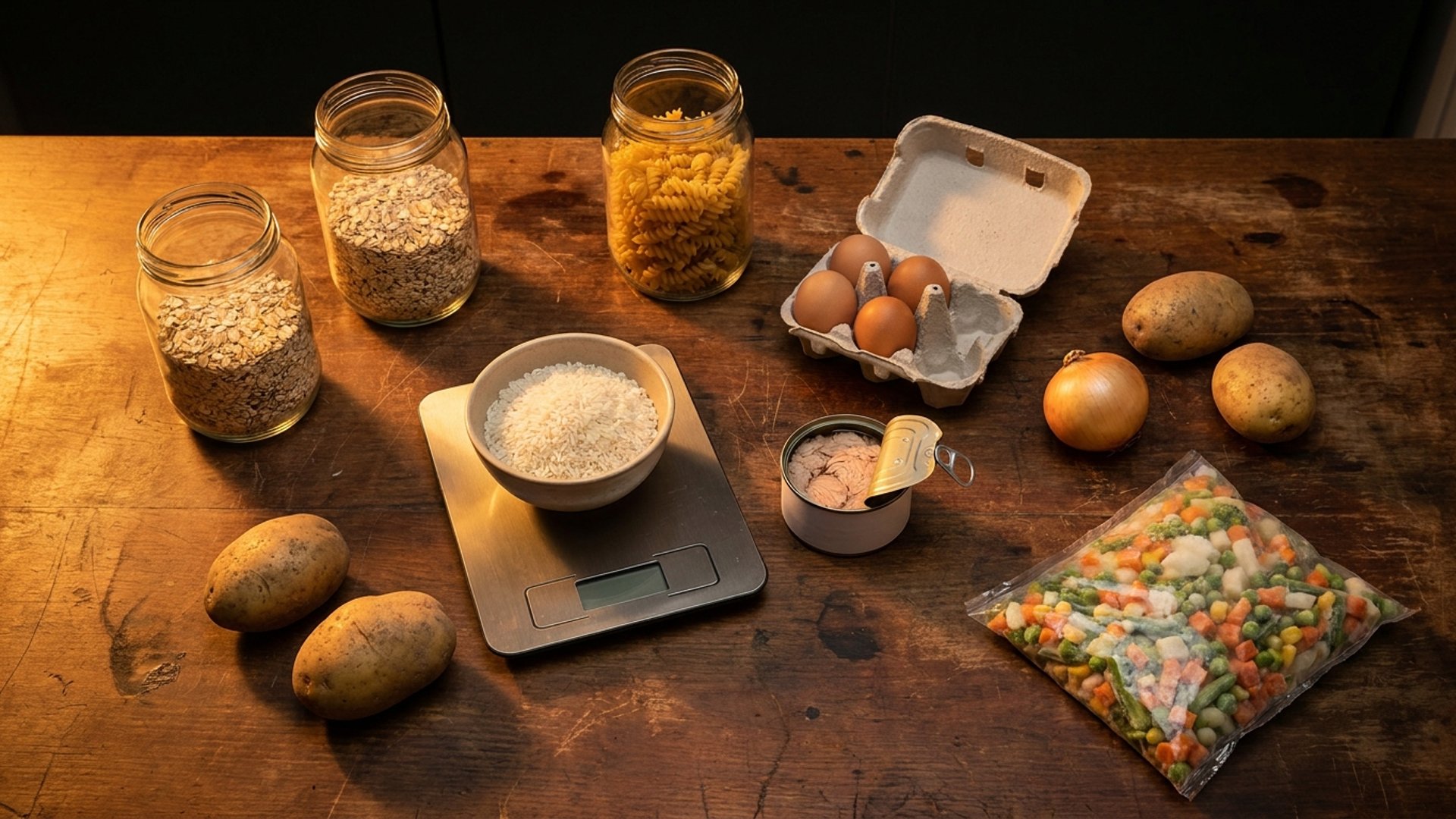
Counting calories on a budget sounds like a compromise. The version of tracking you see online runs on salmon, avocado, and pre-portioned everything, and none of that survives contact with a tight grocery bill.
The two things aren't in tension. Cheap staples are usually the easiest foods to log accurately, because they come as raw ingredients with clean labels instead of restaurant guesses. What actually costs you is a handful of specific errors, and they're fixable.
How big is the price gap, really
There's a meta-analysis for this. Rao and colleagues pooled 27 studies from 10 countries, adjusted for inflation and purchasing power, and compared prices of healthier versus less healthy foods and diet patterns.
Comparing the healthiest diet patterns against the least healthy, the difference was $1.48 per day, or $1.54 per 2,000 calories, in 2011 international dollars. Real money over a year, and not the chasm the framing usually implies.
The more useful finding is where that gap lives:
| Food group | Price difference, healthier vs less healthy |
|---|---|
| Meats and protein | +$0.29 per serving (+$0.47 per 200 kcal) |
| Snacks and sweets | +$0.12 per serving |
| Grains | +$0.03 per serving |
| Fats and oils | +$0.02 per serving |
| Dairy | -$0.004 per serving (essentially zero) |
| Soda and juice | No significant difference |
Most of the gap is protein. Grains, dairy, and fats barely move. So the budget question isn't "how do I afford healthy food," it's "how do I get enough protein cheaply," which is a much narrower problem with well-known answers: eggs, canned fish, dried legumes, whole chicken, tofu, cottage cheese, milk.
If money is tight, spend it on protein and buy everything else on price. In the research, every other food group differed by a few cents a serving at most.
Why cheap calories get tracked badly
Cheap food isn't harder to track because it's cheap. It's harder because cheap-per-calorie usually means energy dense.
Two papers from Drewnowski's group made this the standard framing: energy-dense foods built on refined grains, added sugars, and added fats deliver calories at a lower cost than lean protein and produce, which is why they dominate low-cost diets.
That matters for tracking because estimation error scales with calorie density. Eyeball a portion 30 grams wrong and the damage depends entirely on what it was:
| Food | Calories per 100 g | Cost of a 30 g eyeball error |
|---|---|---|
| Potato chips | 545 | 164 calories |
| Peanut butter | 598 | 179 calories |
| Cooked rice | 130 | 39 calories |
| Cabbage | 31 | 9 calories |
Same sloppiness, twenty times the consequence. If you only own the patience to weigh two or three things, weigh the dense ones: oils, nut butters, cheese, and anything fried.
The dry versus cooked trap
This is the single biggest accuracy leak in budget cooking, and it exists because eating cheaply means buying dry goods in bulk.
Dry grains absorb water when they cook. The calories don't change, but the weight roughly triples, so per-100g numbers for dry and cooked versions of the same food are completely different:
| Food | Calories per 100 g |
|---|---|
| Dry white rice | 360 |
| Cooked white rice | 130 |
| Dry oats | 379 |
| Cooked oatmeal | 71 |
| Dry pasta | 371 |
| Cooked pasta | 157 |
Log 200 g of cooked rice against the dry entry and you've recorded 720 calories instead of 260. Do the reverse and you'll wonder why a 2,000-calorie target leaves you starving.
The fix is a habit, not a calculation. Weigh dry, log dry, then divide the finished pot by the number of portions you're going to eat. A cup of dry rice is 648 calories no matter how much water it soaked up, so five equal servings are 130 each and the cooked weight never enters the math.
Bulk bins have the same problem in reverse. The scoop is not a serving. Weigh what comes home, note the total, and portion from there.
Cheap staples that log cleanly
These are the foods that show up on almost every low-cost grocery list, with the numbers you'd actually enter.
| Food | Practical portion | Calories | Protein |
|---|---|---|---|
| Egg | 1 large | 72 | 6 g |
| Dry oats | 1/2 cup dry (40 g) | 152 | 5 g |
| Dry rice | 1/4 cup dry (45 g) | 162 | 3 g |
| Dry pasta | 2 oz dry (57 g) | 211 | 7 g |
| Potato | 1 medium | 161 | 4 g |
| Canned tuna in water | 3 oz (85 g) | 73 | 16 g |
| Chicken breast | 3 oz cooked (85 g) | 140 | 26 g |
| Cottage cheese | 1/2 cup (110 g) | 92 | 12 g |
| Firm tofu | 3 oz (85 g) | 66 | 8 g |
| Whole milk | 1 cup | 149 | 8 g |
| Peanut butter | 1 tbsp (16 g) | 94 | 4 g |
| White bread | 1 slice | 79 | 3 g |
| Cabbage | 1 cup shredded | 28 | 1 g |
| Carrot | 1 medium | 25 | 1 g |
| Onion | 1 medium | 44 | 1 g |
| Banana | 1 medium | 105 | 1 g |
Protein figures are rounded from the per-100g values on each food page.
Two things stand out. Canned tuna and cottage cheese carry a lot of protein for very little money and almost no logging effort, because both arrive with a printed label. And the vegetables at the bottom are so low in calories that precision there is wasted effort. Estimate the cabbage, weigh the peanut butter.
Potatoes deserve a specific mention, and not only on price. Our rice vs potato comparison covers how they stack up per gram, which is not the way most people assume.
Buy satiety, not just calories
The cheapest way to stay in a deficit is to not be hungry, and some cheap foods are far better at that than others.
The classic experiment here is Holt's satiety index from 1995. Thirty-eight foods were served in equal 240-calorie portions, and fullness was rated every 15 minutes for two hours, with white bread set at 100% as the reference.
Boiled potatoes topped the list at 323%, about seven times the score of the croissant at the bottom (47%). Across all 38 foods, satiety correlated positively with protein, fiber, and water content, and negatively with fat. Serving weight mattered too: heavier portions for the same calories scored higher.
Read that list as a shopping strategy and it points at potatoes, oats, and legumes, which happen to be three of the cheapest things in the store.
Legumes have their own evidence. A meta-analysis of nine acute feeding trials found that dietary pulses (beans, peas, chickpeas, lentils) produced 31% greater satiety incremental area under the curve than isocaloric controls. Worth noting the limitation the authors flagged themselves: the same analysis found no significant effect on how much people ate at the next meal, and the trials were small. Pulses make a meal feel more filling. Whether that carries through the whole day is less settled.
Frozen and canned are not a compromise
Frozen vegetables cost less than fresh and don't rot in the drawer. They're also easier to weigh, because they pour.
They also hold up nutritionally. A UC Davis study compared frozen against refrigerated storage across eight commodities including corn, carrots, broccoli, spinach, peas, green beans, strawberries, and blueberries, measuring ascorbic acid, riboflavin, alpha-tocopherol, and beta-carotene. Vitamin C showed no significant difference in five of the eight, and was higher in the frozen samples for the other three. Overall the frozen produce was comparable to fresh and occasionally better. The exception was beta-carotene, which dropped substantially in some frozen items.
Canned goods have a different advantage: the label. Canned tuna, canned beans, and canned tomatoes all come with a nutrition panel and a drained weight, which removes the guesswork. Rinse canned beans if sodium matters to you, and check whether fish is packed in water or oil, because oil-packed adds real calories.
Cook once, log once
Batch cooking is the cheapest way to eat and the most accurate way to track, for the same reason: you do the measuring one time.
- Weigh every ingredient raw as it goes in, including the oil. Write the grams down as you go.
- Enter the whole recipe once, at raw weights, using the recipe calculator.
- Weigh the finished dish, container subtracted.
- Divide into portions by weight rather than by eye. Equal portions are the entire point.
- Save it. Next week the same meal is one tap.
The oil is the step people skip. A tablespoon is roughly 120 calories, and a generous pour into a pan is often two or three of them. Across a week of batch cooking, that's the difference between a deficit and maintenance.
Tracking homemade recipes and meals walks through the edge cases: partial portions, leftovers that get eaten cold, and what to do when someone else adds something to the pot.
A week that stays cheap and stays logged
Not a meal plan. A structure that survives a budget.
- One grain cooked in bulk on Sunday, weighed dry, portioned by weight
- One cheap protein cooked in bulk (whole chicken, a tray of thighs, a pot of lentils)
- Eggs as the flexible protein for any meal that needs rescuing
- Frozen vegetables as the default side, poured straight from the bag onto the scale
- Oats plus milk or yogurt as a breakfast you can log once and repeat
- Canned tuna and cottage cheese for the days you don't cook
Six items, all weighable, all logged from a raw or labeled state. The variety comes from spices and sauces, which cost little and change a meal completely. Track the sauces if they're oil or sugar based; the dry spices round to nothing.
Mistakes that quietly cost you
Logging cooked weight against a dry entry is the expensive one, which is why it got a section to itself above.
Cooking fat gets forgotten constantly. Oil, butter, and the fat that renders out of meat and stays in the pan are all real calories, and none of them are in the raw ingredient you logged.
The package serving count is a suggestion. A bag of rice labeled "4 servings" is telling you what someone hoped you would eat. The total weight printed on it is the fact.
Anything above 400 calories per 100 g deserves the scale. Nut butters, oils, cheese, and dried fruit are where estimation errors get expensive.
Tastes while cooking don't need a gram-level audit, but a few spoonfuls of a rich sauce over a week add up more than people expect.
The bottom line
The price research says most of the healthy-eating premium is concentrated in protein, and the rest of the grocery basket costs about the same either way. That makes budget tracking a targeted problem rather than a general hardship.
Buy protein deliberately and buy everything else on price. Weigh the calorie-dense items and estimate the vegetables. Log dry goods dry. Cook in batches and portion by weight, not by eye.
Cheap ingredients with clean labels are easier to track than almost anything you'd order out.
Frequently Asked Questions
Track Groceries, Not Guesses
Calvin remembers your staples so a cheap week takes seconds to log

References
- Rao et al. 2013 - Do healthier foods and diet patterns cost more than less healthy options? A systematic review and meta-analysis (BMJ Open)
- Drewnowski & Specter 2004 - Poverty and obesity: the role of energy density and energy costs (Am J Clin Nutr)
- Drewnowski & Darmon 2005 - The economics of obesity: dietary energy density and energy cost (Am J Clin Nutr)
- Holt et al. 1995 - A satiety index of common foods (Eur J Clin Nutr)
- Li et al. 2014 - Dietary pulses, satiety and food intake: a systematic review and meta-analysis of acute feeding trials (Obesity)
- Bouzari et al. 2015 - Vitamin retention in eight fruits and vegetables: a comparison of refrigerated and frozen storage (J Agric Food Chem)

Founder & Developer
Ryan is the founder and lead developer of Calvin. With a passion for both technology and health optimization, he built Calvin to solve his own frustrations with manual calorie tracking. He believes that AI can make healthy eating effortless.
Related Articles
How to Track Homemade Recipes and Meals
Step-by-step guide to calculating and tracking calories in homemade recipes. Learn how to log home-cooked meals accurately without overcomplicating your process.
Calorie Cycling Explained: Higher and Lower Days on the Same Weekly Total
Calorie cycling spreads the same weekly total unevenly across seven days. Here is what the matched-calorie trials actually found, and when the uneven version is easier to hold.

How to Count Calories at a Buffet or Potluck Without Weighing Anything
How to count calories at a buffet or potluck when nothing has a label. What the portion research says, which dishes actually cost you, and how to log the plate afterward.