
Meal Prep for Calorie Counting: Log It Once, Eat It All Week
Meal prep for calorie counting is mostly a logging problem, not a cooking problem. Weigh raw once, log the recipe once, then reuse that entry all week.

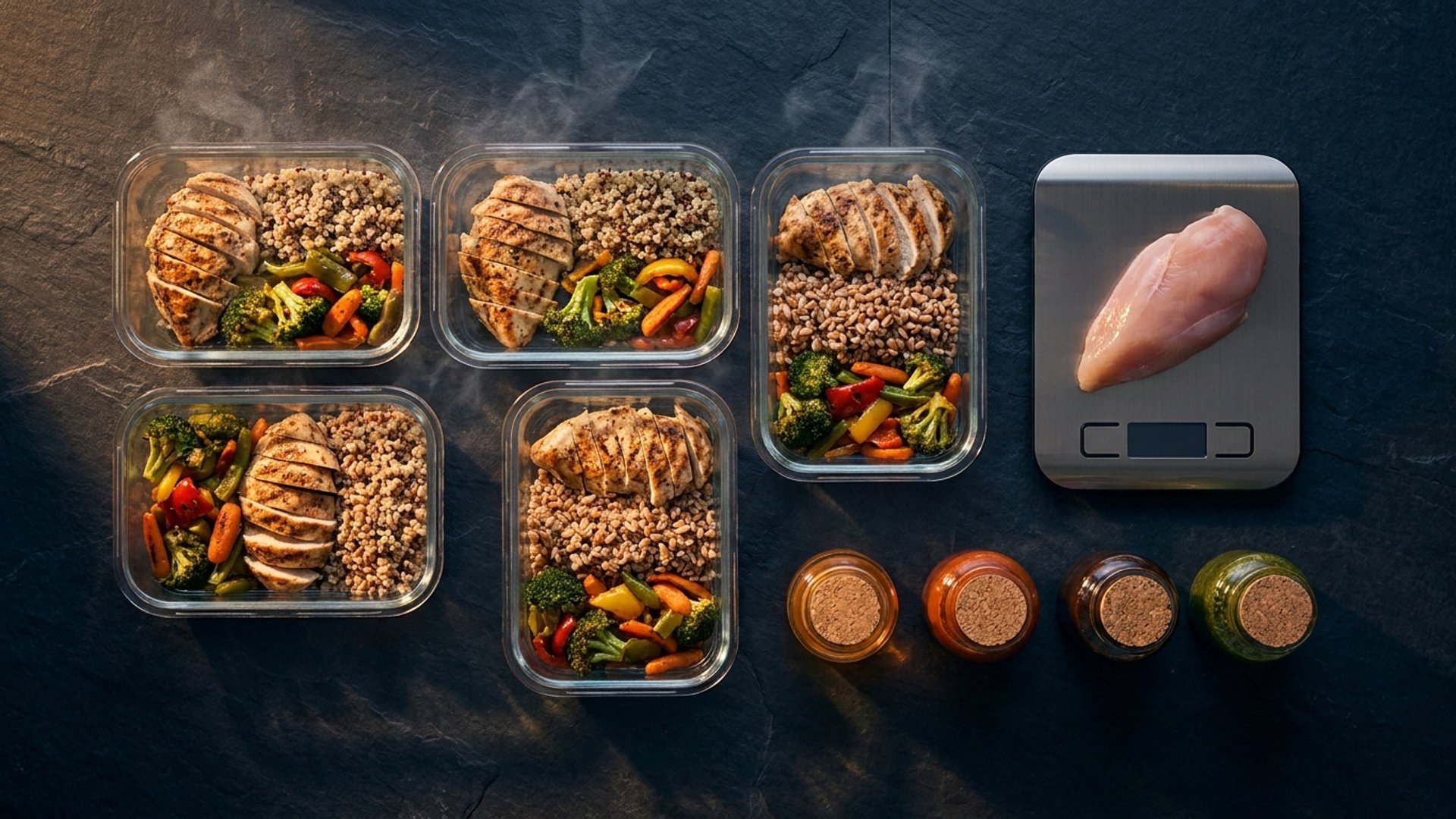
Almost every meal prep guide is written for people who want to save time. Meal prep for calorie counting solves a different problem. Cook five portions at once and weigh them once, and you have bought yourself four meals that are already measured. The olive oil is in the number. The portion is already decided. Accuracy comes free with the tupperware.
That is the part worth building a Sunday around, and it has little to do with the time saved.
The Real Problem Meal Prep Solves
Self-reported intake is unreliable in a specific direction. In a classic study of people who could not lose weight despite reporting fewer than 1,200 calories a day, researchers measured actual intake with indirect calorimetry and body composition analysis and found under-reporting of 47% on average, plus over-reporting of physical activity by about half (51%). Nothing was wrong with their metabolism. The food diary was wrong.
You do not fix that by trying harder to remember. You fix it by reducing how many separate measurement decisions a week contains.
| Approach | Measurement decisions per week | Where error creeps in |
|---|---|---|
| Cook every meal fresh | 15-21 | Oil, portions, sides, "about a cup" |
| Eat out most lunches | 10-14 | Restaurant portions, hidden fats |
| Prep 2 meals x 5 days | 2 | One weighing session, then arithmetic |
Two accurate entries reused ten times beats fourteen quick estimates. Tracking accuracy is mostly a function of how often you have to guess, and prepping cuts the number of guesses rather than improving any single one.
There is observational support for the habit itself. In a survey of over 40,000 French adults, people who planned meals ahead had higher diet quality scores and greater food variety, and planning was associated with lower odds of obesity in both women and men. Cross-sectional data cannot prove that planning caused it. But it runs in the same direction as the NHANES finding that households cooking dinner six or seven nights a week consumed less energy per day than households cooking once or not at all, a difference of roughly 140 calories.
Pre-Logging: The Habit That Does the Work
Here is the flip that makes prep worth it. Log the meal before you eat it, ideally before you cook it.
Standard tracking is a diary. You eat, then you record. Pre-logging is a plan. You write down Tuesday's lunch on Sunday afternoon, and Tuesday's lunch is then a decision that has already been made.
The practical mechanics:
- Build the recipe once with raw ingredient weights
- Divide by the number of containers to get per-portion numbers
- Save it as a reusable entry
- Copy that entry into every day you plan to eat it
Most tracking apps, including Calvin, let you duplicate a logged meal into another day. That single feature is what turns a batch of chili into a week of one-tap logging.
Build a recipe once and get per-portion caloriesPre-logging also front-loads the friction. Deciding what to eat while hungry at 12:40pm is a worse decision than deciding on Sunday with a spreadsheet open. If your evenings tend to fall apart, that timing shift matters more than any macro split.
Weigh Raw, Log Raw
This is the single most common source of error in home-cooked tracking, and it has nothing to do with the recipe.
Water leaves during cooking. Calories do not. A raw chicken breast that weighs 200g might come off the pan at 150g, and if you log 150g of "chicken breast" using a raw-weight database entry, you have just erased 50 grams of chicken from your day.
| Food | Direction of change | Effect if you log cooked weight against raw data |
|---|---|---|
| Chicken, beef, fish | Loses water, gets lighter | Undercounts calories |
| Rice, pasta, oats, beans | Absorbs water, gets heavier | Overcounts calories |
| Roasted vegetables | Loses water, sometimes gains oil | Usually undercounts |
The fix is a rule, not a calculation: weigh and log every ingredient raw, before it goes anywhere near heat. Then divide the total by your container count. The cooked weight of the finished dish is irrelevant to the math, so you never have to know it.
If you do end up needing to portion by cooked weight, weigh the whole finished dish once, then use container weight as a fraction of that total. Six hundred grams of finished stir-fry split into three 200g boxes is one-third of the recipe each, whatever the raw ingredients weighed.
Cooking yields vary with method, cut, and how done you like it, which is exactly why raw-weight logging is the reliable path. Do not memorize a conversion factor and apply it to everything. Weigh before you cook and the problem disappears instead of getting estimated.
What to Batch and What to Leave Alone
Not everything survives five days in a fridge, and not everything needs to.
Batch well:
- Braises, chilis, stews, curries. They improve by day two.
- Roasted root vegetables and squash.
- Grains cooked plain: rice, farro, quinoa, barley.
- Shredded or diced cooked protein kept separate from sauce.
- Hard-boiled eggs.
Batch badly:
- Anything fried or breaded. It goes soft.
- Leafy salads with dressing already on them.
- Avocado, cut apples, anything that browns.
- Delicate fish.
- Pasta already mixed with sauce, which keeps drinking it.
The better system for most people, though, is components rather than complete meals. A fridge stocked with four or five weighed parts that combine differently each day: cooked chicken, cooked grain, a roasted vegetable, a sauce measured into small containers, something crunchy. Each one gets logged once as a per-100g entry, and lunch becomes arithmetic instead of a new estimation problem.
Components also handle boredom, which is the most common reason prep systems collapse by Wednesday. Most people can eat identical containers for about three days before the whole thing starts to feel like a punishment.
Chicken breast vs ground beef for batch cookingBuild the Week Around Protein
Protein is the component worth prepping first, because it is the one people run out of and replace with whatever is nearby.
In a controlled feeding study, raising protein from 15% to 30% of energy while keeping carbohydrate fixed reduced spontaneous calorie intake by about 441 calories a day and produced 4.9 kg of weight loss over 12 weeks, with no instruction to eat less. That was 19 subjects in a tightly controlled setting, so treat the exact number as a ceiling rather than a promise. The direction is well supported: protein is the most satiating macronutrient per calorie, and having it already cooked is what makes it the default choice.
Practical targets for a prep session:
- Cook enough protein for every planned lunch and dinner, plus one spare portion
- Keep it unsauced so it can go a few different directions later in the week
- Weigh the total raw, note it, and portion after cooking
- Aim for the protein your goal actually requires rather than whatever the recipe yields
For a specific number, a 3oz cooked portion of chicken breast runs about 128 calories, most of which is protein, which is why it is the default in so many prep guides. It is not the only answer. Tofu, eggs, canned fish, and lean ground turkey all batch fine and cost less time than the internet suggests.
The 90-Minute Session
A prep session that runs long once will not happen twice. The sequence below fits in about an hour and a half and produces most of a week, mostly by starting the slow things before the fussy ones.
Minute 0 to 10: plan and pre-log
Decide the components. Write them down with target weights. Log the recipes before touching a pan, so the numbers exist before you are tired.
Minute 10 to 20: get heat going
Oven on for roasting vegetables. Grain in a pot or rice cooker. Water on to boil for eggs. Nothing here needs attention once started, and starting them first means the slow items finish while you work.
Minute 20 to 45: weigh and cook protein
Weigh raw, write the number down, then cook. This is the step where accuracy is won or lost, so do it while you are still focused.
Minute 45 to 65: sauces and extras
Portion sauces and dressings into small containers now. Loose dressing is the biggest silent calorie source in an otherwise well-tracked week, since a couple of tablespoons of a creamy dressing can carry more calories than the protein it goes on.
Minute 65 to 85: portion and label
Divide into containers. Write the date and the portion fraction on each lid, in marker, on tape. Labeling matters more than it sounds like it does, because a container with no label becomes a guess three days later.
Minute 85 to 90: copy the entries forward
Duplicate the logged meals into the days you plan to eat them. The week is now tracked.
If 90 minutes is too much, prep one component. A single tray of cooked protein in the fridge removes more decisions than a full five-meal system you do twice and quit.
Why Prepped Food Tracks Better Than Its Packaged Equivalent
"I'll just buy the prepared version" is a reasonable shortcut, and it does still beat guessing at a restaurant. It is worth knowing what you give up, though, and ingredient quality is only part of it.
In a fully controlled inpatient trial, 20 adults ate ultra-processed and unprocessed diets for two weeks each, matched for presented calories, energy density, macronutrients, sugar, sodium and fiber, with instructions to eat as much or as little as they wanted. On the ultra-processed diet they ate about 508 more calories a day and gained 0.9 kg; on the unprocessed diet they lost 0.9 kg. Same numbers on paper, different amounts eaten.
Twenty people is a small trial and the mechanism is still argued over. It does point at something prep gives you for free, though. Food you assembled yourself, in a portion you decided on before you were hungry, is easier to stop eating than food designed to be finished.
Where Prep Systems Fail
Portions drift. The containers start at 400g, and by Thursday you are topping them off because the pot happened to yield more than you thought. Weigh the containers for the first couple of weeks, until your hand calibrates.
Then there is everything prep does not cover. It handles lunch and dinner, not the handful of nuts at 4pm, not the cooking oil you never measured, not the bite of everything while cooking. Log the oil especially. It is the highest-calorie thing in most kitchens and the easiest to pour without thinking.
Most systems also run Monday to Thursday and then expire on the exact days structure is weakest. A prepped Saturday breakfast is worth more than a fifth identical lunch.
The last failure is the most common. A system needing three hours on Sunday and six containers of steamed broccoli is a system built for a fictional version of you. Build for the version who is tired.
What to do on the days you have no scaleGetting the First Week Right
Keep the first attempt small enough that it succeeds.
- One protein, one grain, one vegetable, one sauce
- Four portions, not seven
- Everything weighed raw and logged before cooking
- Entries copied into the days you plan to eat them
- One note at the end of the week about what you actually ate versus what you planned
That last one is the feedback loop, and it is the item people skip. Most of us plan for a version of the week that does not happen, and the gap between the plan and the fridge is where the useful information lives. Move the plan toward what you actually ate. It is a lot easier than the other direction.
Log the recipe once
Calvin saves your prepped meals so a week of tracking is a few taps

References
- Ducrot P et al. 2017 - Meal planning is associated with food variety, diet quality and body weight status in a large sample of French adults (Int J Behav Nutr Phys Act)
- Wolfson JA, Bleich SN 2015 - Is cooking at home associated with better diet quality or weight-loss intention? (Public Health Nutrition)
- Lichtman SW et al. 1992 - Discrepancy between self-reported and actual caloric intake and exercise in obese subjects (New England Journal of Medicine)
- Weigle DS et al. 2005 - A high-protein diet induces sustained reductions in appetite, ad libitum caloric intake, and body weight (American Journal of Clinical Nutrition)
- Hall KD et al. 2019 - Ultra-processed diets cause excess calorie intake and weight gain: an inpatient randomized controlled trial of ad libitum food intake (Cell Metabolism)

Founder & Developer
Ryan is the founder and lead developer of Calvin. With a passion for both technology and health optimization, he built Calvin to solve his own frustrations with manual calorie tracking. He believes that AI can make healthy eating effortless.
Related Articles

How to Track Coffee Shop Drinks: Latte Calories, Milk Math, and Hidden Syrups
Latte calories range from 130 to over 400 depending on milk, size, and syrup. Here's how to track any coffee shop drink without guessing.
How to Track Condiment Calories: Sauces, Dressings, and Cooking Fats
Condiment calories are the most common gap in food logs. Here's what dressings, sauces, and cooking fats actually cost, and a system for tracking them.

How to Get Back on Track After a Binge (Without the Guilt Spiral)
Binges happen. The damage isn't what you ate. It's what you do next. Here's the calm, evidence-based playbook for resetting after an off day without spiraling.