

How to Track Condiment Calories: Sauces, Dressings, and Cooking Fats
Condiment calories are the most common gap in food logs. Here's what dressings, sauces, and cooking fats actually cost, and a system for tracking them.

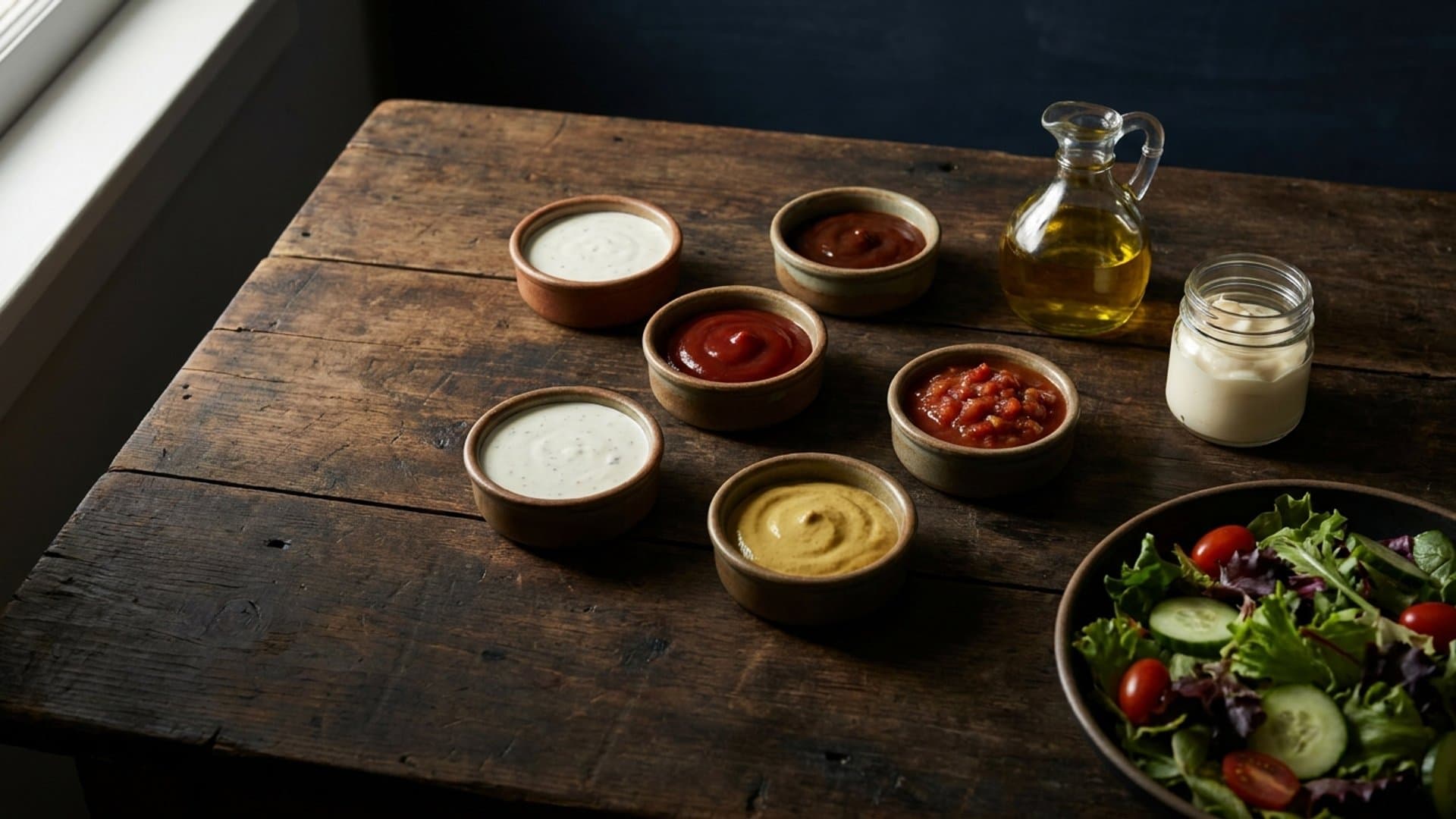
Most people who track calories get the main parts of a meal roughly right. The chicken gets weighed, the rice gets measured, the log looks clean. Then the meal gets dressed: oil in the pan, mayo on the bread, ranch on the side. None of it makes the log, and those condiment calories quietly add up to a few hundred a day.
That gap matters more than it sounds. A famous 1992 study in the New England Journal of Medicine found that people who believed they couldn't lose weight underreported their actual intake by an average of 47%. Condiments and cooking fats are exactly the kind of food that goes missing, because nobody mentally files a mayo smear or a pan of oil under "things I ate today."
This guide covers what sauces, dressings, and cooking fats actually cost (every number below comes from our own food pages, sourced from USDA data), which ones you can basically ignore, and a tracking system that takes about ten extra seconds per meal.
Why Condiments Break Food Logs
Three things make condiments uniquely easy to miss.
They're calorie dense. Most of the expensive ones are mostly fat, and fat has 9 calories per gram, more than twice the 4 calories per gram of protein or carbs. A tablespoon of mayonnaise is 14 grams of food and 94 calories. You'd need to eat about two cups of strawberries to match it.
They're invisible at logging time. You log "turkey sandwich," not "turkey sandwich plus the tablespoon of mayo spread on each slice." The sandwich is the thing you remember eating. The mayo is just how the sandwich tasted.
Portions drift. Nobody measures ranch onto a salad with a tablespoon. The "serving" on the label is 2 tablespoons, but a generous pour at home or a restaurant ramekin is easily double that. With something like caesar dressing at 76 calories per tablespoon, the difference between the label serving and a real-world pour can be 150+ calories on a single salad.
A useful mental reframe: condiments aren't seasonings, they're ingredients. You wouldn't skip logging a slice of cheese. A tablespoon of mayo has more calories than one.
What Condiments Actually Cost
Here's the damage, per typical serving. Every figure links to the full nutrition page.
| Condiment | Typical serving | Calories |
|---|---|---|
| Olive oil | 1 tbsp | 119 |
| Butter | 1 tbsp | 102 |
| Mayonnaise | 1 tbsp | 94 |
| Caesar dressing | 2 tbsp | 152 |
| Blue cheese dressing | 2 tbsp | 136 |
| Ranch dressing | 2 tbsp | 120 |
| Honey | 1 tbsp | 64 |
| Guacamole | 2 tbsp | 47 |
| Hummus | 2 tbsp | 70 |
| Italian dressing | 2 tbsp | 67 |
| Ketchup | 1 tbsp | 17 |
| Soy sauce | 1 tbsp | 11 |
| Salsa | 2 tbsp | 9 |
| Mustard | 1 tsp | 3 |
| Hot sauce | 1 tsp | 1 |
Notice the spread. The gap between the top and bottom of that table is enormous: a salad dressed with 2 tablespoons of caesar costs 152 calories, while the same salad with salsa costs 9. Same behavior, completely different math.
The pattern is simple: if it's built on oil, egg, or dairy fat, it's expensive. If it's built on vinegar, tomato, peppers, or mustard seed, it's nearly free.
The Salad Dressing Problem
Salads deserve their own section because dressing is where the "I eat healthy but can't lose weight" story so often lives.
Take a typical lunch salad: greens, cherry tomatoes, cucumber, grilled chicken. The vegetables might total 50 calories, the chicken around 200. Then comes the dressing:
- Label serving (2 tbsp) of ranch: 120 calories
- A realistic restaurant ramekin (4 tbsp): around 240 calories
- A heavy pour plus the oil already tossed in the greens: potentially 300+
At that point the dressing rivals the chicken as the most caloric thing in the bowl. The salad is still a fine meal. It's just not the 250-calorie meal the log says it is.
Three ways to handle it:
- Get dressing on the side and dip your fork. You'll typically use a fraction of the poured amount while still tasting dressing in every bite.
- Switch the base. Moving from caesar (76 cal/tbsp) to italian (34 cal/tbsp) cuts the cost roughly in half without giving up a creamy-adjacent texture.
- Log the honest amount. If you drowned the salad, log 4 tablespoons. A high number in the log beats a wrong one.
Cooking Fats: the Condiment You Never See
Oil and butter used in cooking are the sneakiest entries in this whole category, because they're invisible by the time the food hits your plate.
A tablespoon of olive oil is 119 calories. A tablespoon of butter is 102. Most home cooks pour two or three tablespoons into a pan without thinking, and some of it ends up in the food, especially with absorbent ingredients like eggplant, mushrooms, rice, and breaded anything.
Which fat you cook with matters less than how much. Olive oil, avocado oil, butter, and ghee all land between roughly 100 and 126 calories per tablespoon, because they're all nearly pure fat. There's no low-calorie cooking oil. (For the health side of the butter vs olive oil question, we've compared them in detail: butter vs olive oil.)
Practical rules that work:
- Measure once, then calibrate. Pour your normal "glug" into a tablespoon one time. Most people discover their casual pour is 2 to 3 tablespoons. After that, you can log your usual pour from memory.
- Log the pan fat with the meal. When you cook in oil, add a half to full tablespoon to the log per serving, depending on how much stayed in the pan.
- Use spray for low-stakes cooking. One spray of olive oil cooking spray is about 4 calories. For eggs or reheating, it does the job of a tablespoon at a thirtieth of the cost.
If you batch-cook, it's easier to log the whole bottle's worth of oil into the recipe once and let the per-serving math sort itself out. Our recipe calorie calculator handles exactly this, and our guide to tracking homemade recipes walks through the full workflow.
The "Basically Free" List
Tracking every gram of every condiment is a fast route to burnout, and with some of them the math genuinely doesn't justify the effort. These are low enough that a normal serving barely registers:
- Mustard: 3 calories per teaspoon. Use it like it's water.
- Hot sauce: about 1 calorie per teaspoon. Watch the sodium if that matters to you, but the calories are a rounding error.
- Salsa: 9 calories per 2 tablespoons. Possibly the best calorie-to-flavor ratio in the grocery store.
- Soy sauce: 11 calories per tablespoon.
- Vinegar, lemon juice, pickled jalapeños, and most pickles sit in the same near-zero range.
My honest advice: don't log these at all unless you're using them in cup quantities. Spend your tracking attention on the fats, where a single eyeballed serving can be off by 100 calories, not on the mustard, where being off by triple costs you 6.
One trap in the "free" category: anything labeled "fat free" that's also sweet. Fat free dressings often replace oil with sugar, landing around 20 to 50 calories per 2 tablespoons. Cheaper than ranch, but not free, and the label serving is still smaller than most pours.
A 10-Second System for Tracking Condiments
You don't need to weigh ketchup packets to fix this. You need a default habit. Here's the system:
- Audit one normal day. For one day, measure the condiments and cooking fats you actually use: the oil pour, the mayo spread, the dressing pour. You're not changing anything yet, just finding your real numbers.
- Build your defaults. Most people use the same 4 to 6 condiments in the same amounts almost every day. Save them as quick-add entries: "pan olive oil, 1 tbsp," "sandwich mayo, 1 tbsp," "salad ranch, 3 tbsp." Calibrated once, reused forever.
- Log the fat first. When you log a meal, add the condiment before the main ingredients. It's the part you'll forget, so make it the part you do first.
- Round up when unsure. Restaurant sauce portions are generous and restaurant kitchens cook with more fat than you do. When estimating someone else's cooking, take your guess and add a third. Our guide to tracking restaurant meals goes deeper on this.
- Re-measure once a month. Pours drift. A 30-second check keeps your defaults honest.
The goal isn't gram-perfect mayo logs. It's eliminating a systematic blind spot. Being consistently within 20 calories on condiments beats randomly missing 300.
Where This Fits in the Bigger Accuracy Picture
Condiments are one of a handful of foods that quietly wreck otherwise solid logs. Cooking oils and dressings top the list, but nut butters, cheese, and "healthy" snacks pull the same trick: a small portion that carries far more calories than it looks like it should. We've ranked the worst offenders in our guide to the most underestimated foods in calorie counting.
If you're eating in a deficit and the scale isn't moving, an unlogged 200 to 400 calories of condiments and cooking fat is one of the most common explanations, and one of the easiest to fix. You don't have to give up ranch. You just have to put it in the log.
Frequently Asked Questions
Log the Whole Meal, Sauce Included
Calvin makes condiments one tap to add, so your log matches what you actually ate

References
- Lichtman et al. 1992 - Discrepancy between self-reported and actual caloric intake and exercise in obese subjects (NEJM)
- Subar et al. 2003 - Using intake biomarkers to evaluate the extent of dietary misreporting in a large sample of adults: the OPEN study (American Journal of Epidemiology)
- USDA FoodData Central

Founder & Developer
Ryan is the founder and lead developer of Calvin. With a passion for both technology and health optimization, he built Calvin to solve his own frustrations with manual calorie tracking. He believes that AI can make healthy eating effortless.
Related Articles

How to Track Coffee Shop Drinks: Latte Calories, Milk Math, and Hidden Syrups
Latte calories range from 130 to over 400 depending on milk, size, and syrup. Here's how to track any coffee shop drink without guessing.
Meal Prep for Calorie Counting: Log It Once, Eat It All Week
Meal prep for calorie counting is mostly a logging problem, not a cooking problem. Weigh raw once, log the recipe once, then reuse that entry all week.
The Most Underestimated Foods: Where Calorie Counting Goes Wrong
Discover the foods that sabotage calorie counts the most. From cooking oils to 'healthy' options, learn where hidden calories hide and how to account for them.