

Why You Overeat on Weekends (And How to Fix It)
Research shows most people eat more on weekends. Here's why the 'Monday diet' phenomenon happens and practical strategies to stop sabotaging your progress.


If you've ever felt like you eat well during the week but lose control on weekends, you're not alone. And it's not a willpower problem. Most people eat measurably more on Saturday and Sunday. Understanding why is the first step to fixing it.
The Pattern Is Real
A 2008 study by Racette et al. found that adults consume an average of 115 extra calories per day on weekends compared to weekdays. Other research puts the figure even higher.
That might not sound like much, but let's do the math:
| Scenario | Extra Weekend Calories | Weekly Impact | Monthly Impact |
|---|---|---|---|
| Conservative (+115/day) | 230 cal | 920 cal | ~1 lb/month |
| Moderate (+300/day) | 600 cal | 2,400 cal | ~2.5 lbs/month |
| Significant (+500/day) | 1,000 cal | 4,000 cal | ~4 lbs/month |
Two days of overeating can completely erase a week of careful eating. A 500-calorie daily deficit Monday through Friday (2,500 total) disappears if you eat 1,250 extra calories each weekend day.
This is why so many people feel stuck. They're disciplined most of the time, but weekends undo the math.
Why Weekends Derail You: The Six Factors
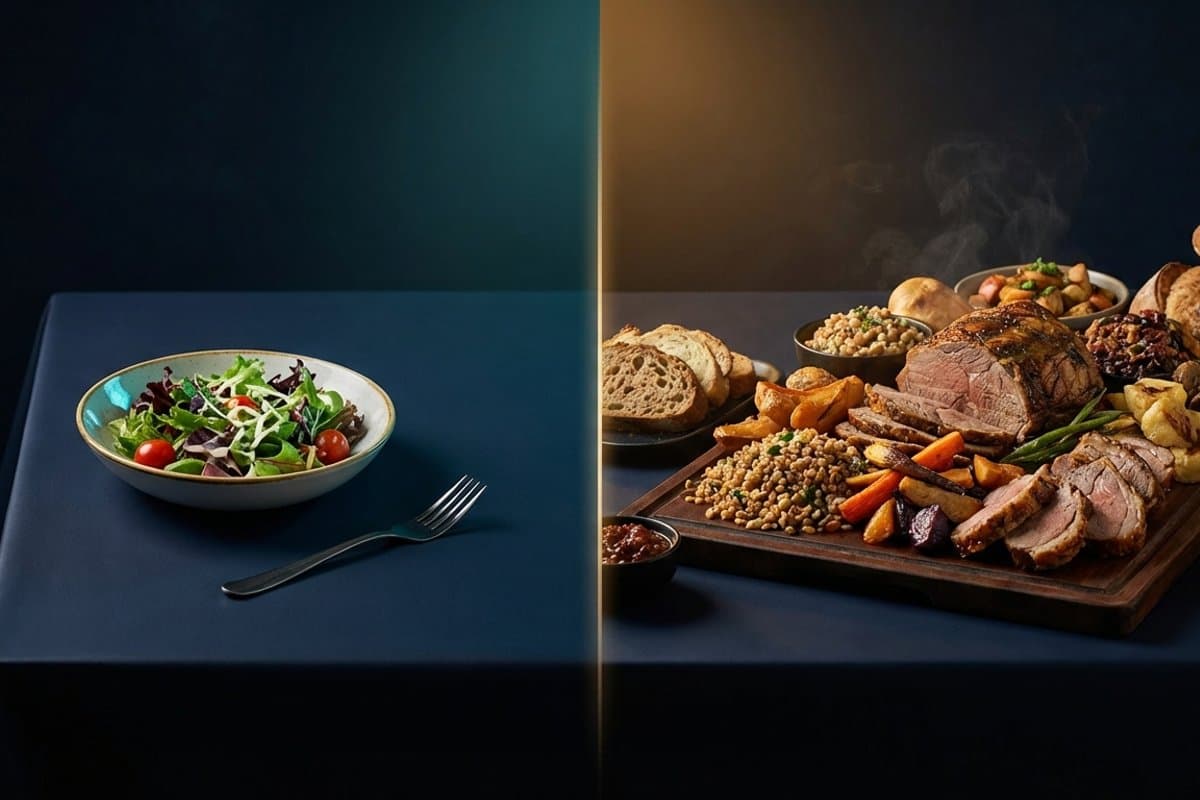
1. Loss of Structure
Weekdays have built-in structure: wake up at a set time, meals at predictable hours, work that occupies your mind. Weekends often lack this framework.
What happens:
- Irregular meal times lead to excessive hunger
- Boredom creates opportunities for snacking
- No routine means more spontaneous food decisions
Research on eating behavior consistently shows that unstructured time correlates with higher calorie intake. It's not that you have less willpower on weekends. You have more decisions to make and fewer guardrails.
2. Social Eating
Weekends are social. Brunches, dinners out, parties, barbecues, family gatherings. Social situations change eating behavior in predictable ways:
- Meals last longer (more time to eat = more food consumed)
- Portion sizes are larger at restaurants
- Social pressure to eat what others are eating
- Shared appetizers and family-style plates encourage overserving
Studies show people eat roughly 44% more when dining with others compared to eating alone. The more people at the table, the more everyone eats.
How to track meals when eating out3. Alcohol
Weekend drinking affects weight through multiple pathways:
| Effect | Impact |
|---|---|
| Liquid calories | 150-300 cal per drink (often 3-4+ drinks) |
| Lowered inhibitions | Worse food choices, larger portions |
| Late-night eating | Post-drinking snacks and fast food |
| Next-day cravings | Hangover eating often adds 500+ calories |
A 2010 study by Yeomans found that alcohol consumption increased food intake by about 11% in the meal that followed. Combine the calories from drinks with the subsequent overeating, and a night out can easily add 1,500+ calories.
Understanding alcohol's calorie impact4. The "I Deserve It" Mindset
You worked hard all week. You ate salads. You went to the gym. You deserve a reward, right?
This reward mindset is psychologically natural but mathematically problematic. The calories you "earn" through good behavior aren't stored somewhere waiting to be spent. Your body doesn't keep a moral ledger.
The pattern:
- Mon-Fri: restriction and discipline
- Weekend: compensation and "treats"
- Result: net zero progress (or worse)
5. All-or-Nothing Thinking
One "bad" meal can spiral into a bad day, which becomes a bad weekend.
"I already had pancakes for brunch, so the day is ruined, might as well have pizza for dinner and start fresh Monday."
This turns a 400-calorie "mistake" into a 2,000-calorie binge. Sunk cost fallacy applied to eating.
6. Sleep Schedule Disruption
Staying up later on weekends and sleeping in disrupts your circadian rhythm, which affects:
- Hunger hormone regulation (ghrelin and leptin)
- Impulse control and decision-making
- Energy levels and activity
Even one night of poor sleep increases hunger and cravings the next day. Two nights of disrupted sleep (Friday and Saturday) sets you up for eating more all weekend.
The Math That Matters
Here's why weekends are so critical for weight management:
Example: Aiming for 1 lb/week weight loss (requires 500 cal/day deficit)
| Day | Target | Actual | Difference |
|---|---|---|---|
| Monday | 2,000 | 1,900 | -100 |
| Tuesday | 2,000 | 2,000 | 0 |
| Wednesday | 2,000 | 1,950 | -50 |
| Thursday | 2,000 | 2,100 | +100 |
| Friday | 2,000 | 2,200 | +200 |
| Saturday | 2,000 | 3,000 | +1,000 |
| Sunday | 2,000 | 2,800 | +800 |
Weekly total: +1,950 calories (gaining, not losing)
This person was "good" Monday through Thursday, slightly over on Friday, and significantly over on the weekend. Despite feeling like they were dieting most of the week, they ended up in a surplus.
Your body averages your calories over time. Five good days can't compensate for two very bad days if the math doesn't work out.
Practical Fixes for Each Problem
For Loss of Structure: Create Weekend Routines
- Wake up within 1 hour of your weekday time
- Plan meals the same way you'd plan weekday meals
- Schedule activities that get you out of the kitchen
- Prep weekend breakfasts and lunches in advance
For Social Eating: Strategic Choices
- Check menus in advance and decide what to order before arriving
- Eat a small protein-rich snack before social events
- Volunteer to be the designated driver (saves alcohol calories)
- Practice the "one plate rule" at buffets and parties
- Share desserts instead of ordering your own
For Alcohol: Harm Reduction
- Set a drink limit before going out
- Alternate alcoholic drinks with water
- Choose lower-calorie options (light beer, wine, spirits with zero-cal mixers)
- Eat a protein-rich meal before drinking
- Plan your post-drinking food in advance (have something ready at home)
For "I Deserve It" Thinking: Reframe Rewards
- Find non-food rewards (massage, sleeping in, new book, experience)
- If food is the reward, make it specific and planned (not open-ended)
- Question whether restriction all week is sustainable if it requires compensation
For All-or-Nothing Thinking: Damage Control
- One bad meal doesn't ruin a day; one bad day doesn't ruin a week
- After overeating, just return to normal at the next meal
- Track even when you go over, data helps you learn
- Remember: a 300-calorie "damage control" day is better than a 2,000-calorie "screw it" day
For Sleep Disruption: Protect Your Schedule
- Limit weekend sleep schedule deviation to 1 hour
- If you stay up late, still try to wake at a reasonable time
- Avoid screens before bed
- If you know you'll have a late night, nap earlier rather than sleeping in the next day
The Weekend-Proof Strategy
Instead of treating weekends as a break from your diet, think in weekly terms.
Weekly budget approach:
- Calculate your weekly calorie target (TDEE × 7 minus weekly deficit goal)
- Allocate slightly fewer calories Monday through Thursday
- Allow slightly more Friday through Sunday
Example for someone with 2,000 cal/day TDEE wanting to lose 1 lb/week:
| Days | Daily Calories | Total |
|---|---|---|
| Mon-Thu | 1,700 | 6,800 |
| Fri-Sun | 2,100 | 6,300 |
| Weekly Total | 13,100 | |
| Weekly TDEE | 14,000 | |
| Weekly Deficit | 900 |
This approach works with your natural patterns instead of against them. You get more flexibility on weekends without derailing progress.
Set a sustainable weekly deficitWhat Actually Works: Research Summary
Studies on successful long-term weight management point to a few common factors:
- Consistent eating patterns across all days (weekend eating similar to weekday)
- Self-monitoring that continues through weekends
- Planning ahead for challenging situations
- Flexible restraint rather than rigid all-or-nothing rules
- Physical activity maintained on weekends
People who maintain weight loss long term don't take weekends off. They've learned to enjoy weekends without abandoning the diet entirely.
The Bottom Line
Weekend overeating is one of the most common patterns sabotaging weight management. It's not a character flaw. It's a predictable response to less structure, more social eating, alcohol, reward mindset, and disrupted sleep.
The fix isn't more willpower. It's:
- Some structure on weekends
- A plan for social situations
- Managing alcohol deliberately
- Thinking in weekly (not daily) terms
- Tracking even when you go over
Two days out of seven is 29% of your week. You can't write off 29% and expect results.
Why evening eating patterns matterFrequently Asked Questions
Track All Seven Days
Calvin makes it easy to stay consistent, weekdays and weekends alike

References
- International Journal of Obesity - Weekend-weekday energy intake patterns
- Racette et al. 2008 - Influence of weekend lifestyle patterns on body weight (Obesity)
- Yeomans 2010 - Alcohol, appetite and energy balance: is alcohol intake a risk factor for obesity? (Physiology & Behavior)
- de Castro 1991 - Weekly rhythms of spontaneous nutrient intake and meal pattern of humans (Physiology & Behavior)

Founder & Developer
Ryan is the founder and lead developer of Calvin. With a passion for both technology and health optimization, he built Calvin to solve his own frustrations with manual calorie tracking. He believes that AI can make healthy eating effortless.
Related Articles

Your First Week of Calorie Tracking: What to Expect
The first week of calorie tracking is slow, noisy, and slightly annoying. Here is how long it actually takes, what the scale will do, and what counts as good enough.
Decision Fatigue and Food Choices: Why Your Eating Falls Apart at Night
If your eating is great during the day but falls apart in the evening, decision fatigue is likely part of the problem. Here's the science and how to fix it.

Should You Eat Back Exercise Calories? When It Makes Sense (And When It Doesn't)
Your watch says you burned 400 calories, should you eat them back? Here's when it makes sense, when it doesn't, and why fitness trackers get it wrong.