

Can Certain Foods Target Belly Fat? What the Research Actually Found
No food burns belly fat on demand. But one dietary factor tracks with visceral fat in long-term data, and the studies that tested spot reduction directly are worth reading.

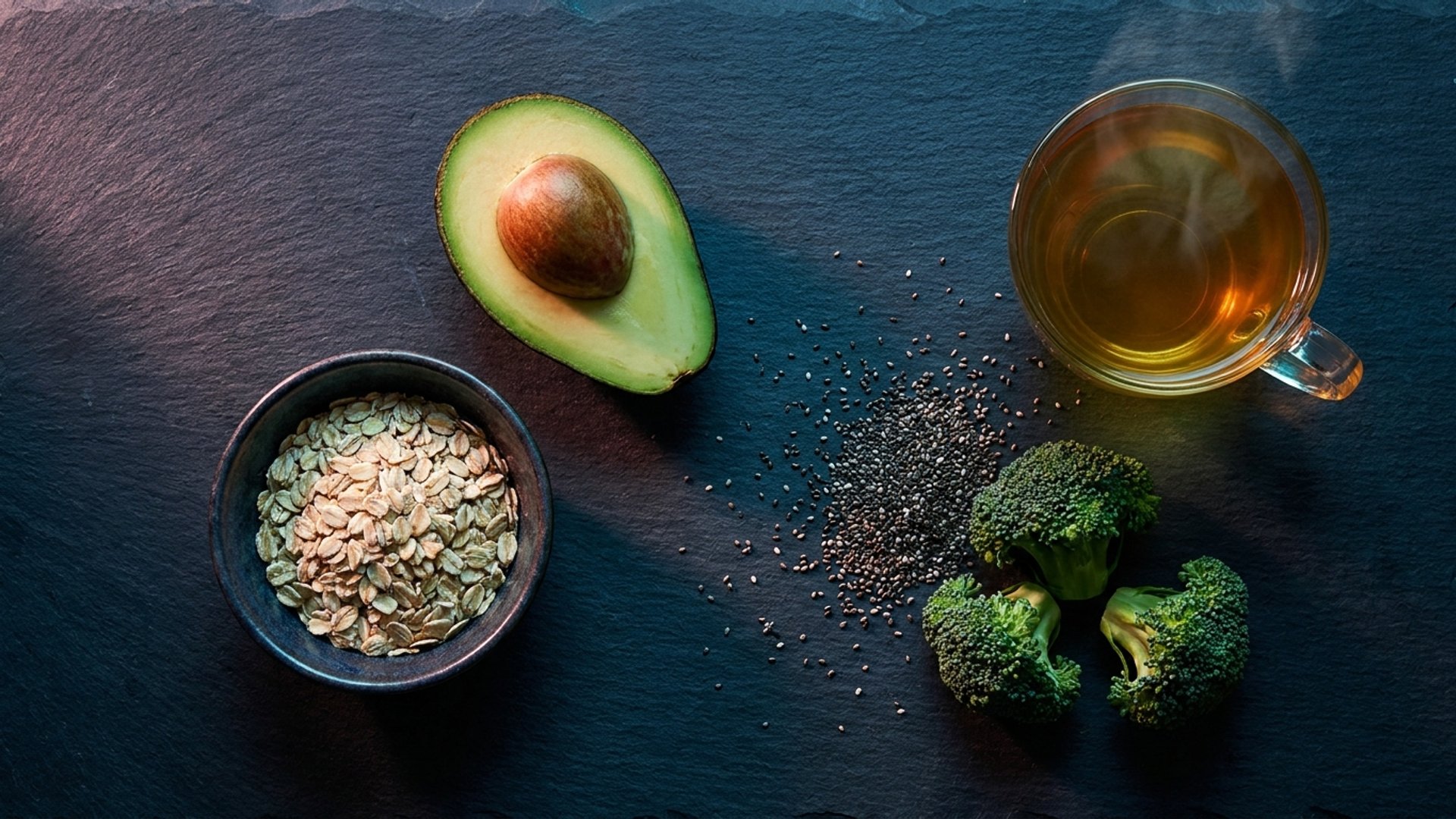
Search for foods that target belly fat and you will get lists. Avocado, green tea, almonds, and whatever the current entry is. The lists are not wrong about the foods being decent foods. They are wrong about the mechanism, and the mechanism is the whole claim.
Fat leaves storage as free fatty acids into the bloodstream, which then delivers them wherever the body needs fuel. Nothing in that pathway carries an address. A food you ate an hour ago has no way to point at your midsection, and neither does an exercise, which is why the experiments that tested the idea directly are the most interesting thing in this topic.
The Two Studies That Tested Spot Reduction Head On
If any localized effort could shrink the fat sitting over it, abdominal training would be the clearest case. It is the one everybody does for exactly that reason.
Vispute and colleagues took 24 sedentary adults and randomized them to six weeks of abdominal training or nothing. The training group did seven abdominal exercises, two sets of ten, five days a week. Everyone held their diet steady at the same calorie intake. Body fat percentage, android fat, abdominal circumference, and abdominal skinfolds all failed to change. The only thing that improved was abdominal muscular endurance, which went up substantially. They got better at the exercise. The fat over the muscle did not care.
The second study is stranger and more convincing. Ramírez-Campillo and colleagues had eleven people train one leg only, for twelve weeks, with very high repetition leg presses at light loads. If fat came off preferentially where the work was done, the trained leg should have led. Fat mass fell in the upper extremities by 10.2% and in the trunk by 6.9%, while the trained leg showed no significant change. Total body fat mass dropped 5.1%. Energy intake was unchanged across the study.
Fat came off, and it came off everywhere except the limb doing the work. Whatever governs the order in which your body draws down its fat stores, it is not local demand.
If a leg working four figures' worth of repetitions cannot claim its own fat, a food eaten three times a week is not going to.
Where the Fat Goes When You Lose It
Distribution is largely set by things you do not choose. Sex hormones, genetics, and age dominate. Men store more abdominally and lose from there earlier in a deficit; women lose proportionally more visceral fat relative to total fat loss, which the POUNDS LOST data picked up directly.
That trial is useful here because it is one of the few to measure abdominal fat by CT during real weight loss across genuinely different diets. Participants were assigned to four calorie-reduced diets varying protein from 15% to 25%, fat from 20% to 40%, and carbohydrate from 35% to 65%. At six months, visceral fat fell 16.1% and abdominal subcutaneous fat fell 13.6%, with no differences between the diets.
Two things fall out of that:
- Visceral fat is not stubborn. It came off slightly faster than the subcutaneous fat around it, which matches what other imaging studies find. The deep abdominal fat is the responsive kind. The layer you can pinch is the one that lingers.
- Macronutrient ratio did not steer it. High protein, low fat, low carb, all landed in the same place once calories were matched.
The trial has one more number worth carrying: participants regained roughly 40% of their losses by the two-year mark, again with no difference between diets. The diet you pick decides very little. Whether you stay on it decides most of it.
The difference between losing weight and losing fatThe One Dietary Signal That Survived Five Years
Here is the closest thing to a real answer, and it is narrower than the headlines built on it.
The IRAS Family Study scanned 1,114 adults by CT, then scanned them again five years later, measuring visceral and subcutaneous fat separately. Against a long list of lifestyle variables, one dietary factor came through. For each additional 10 g of soluble fiber per day, the rate of visceral fat accumulation dropped by 3.7%, independent of any change in BMI. Soluble fiber had no association with subcutaneous fat at all. Physical activity showed a similar pattern, with moderately active participants accumulating visceral fat 7.4% more slowly than less active ones.
Read that carefully, because the popular version gets it backwards.
This is a slower rate of accumulation over five years in an observational cohort, not fat loss. It does not say fiber removes belly fat. It says that among people whose abdominal fat was creeping up, the ones eating more soluble fiber crept up more slowly.
It is also a big dose. Ten grams of soluble fiber per day is more than many people's total fiber intake, and total fiber is what food labels and our own food pages report. Oats, barley, beans, lentils, apples, and citrus are the usual soluble fiber sources; the numbers below are total fiber, so treat them as a starting point rather than a soluble fiber count.
| Food | Fiber per 100g | Calories per 100g |
|---|---|---|
| Chia seeds | 34.4 g | 486 |
| Almonds | 12.5 g | 579 |
| Avocado | 6.7 g | 160 |
| Broccoli | 2.6 g | 34 |
| Oatmeal, cooked | 1.7 g | 71 |
Oatmeal looks weak in that column and is not, because nobody eats 100 g of it. Cooked oatmeal is mostly water, and a standard 234 g bowl carries 166 calories and about 4 g of fiber. Chia looks unbeatable and is not, because 100 g of chia is 486 calories and a realistic serving is 12 to 28 g.
The mechanism by which fiber affects the calories you actually absorb is a separate story, told in how fiber affects calorie absorption.
The Foods Sold Hardest for This, and What Their Trials Show
Green tea is the most heavily marketed belly fat food there is, and it has been through a Cochrane review, which is about as clean a verdict as nutrition offers. Across six trials conducted outside Japan, the mean difference in weight loss was 0.04 kg in favor of green tea, statistically non-significant, and across the five that measured waist circumference the difference was 0.2 cm. Trials conducted in Japan showed larger and more variable effects that could not be pooled. The reviewers' conclusion was that green tea produces a small weight loss unlikely to be clinically important.
That is not an argument against drinking it. Green tea runs about 2 calories per 240 ml cup, so it is a free swap for anything sweetened, and the swap is worth more than the catechins are.
The pattern generalizes. Foods marketed for belly fat tend to be foods that are filling, low in calories for their volume, or high in protein. Those properties help, and they help by making your overall intake easier to hold down, not by routing lipolysis to your waistline. That is the actual mechanism behind high volume eating, and it is worth using deliberately rather than accidentally.
What Does Move a Waist Measurement
Nothing here is proprietary and none of it is fast.
Start with a calorie deficit you can hold for months. Every study above that reduced abdominal fat did it with an energy deficit, and none of them did it with a food. Size that deficit so it survives contact with a normal week rather than an ideal one.
Keep protein high enough that the weight you lose stays weighted toward fat. What you lose matters more than how quickly you lose it, and protein is the lever with the most evidence behind it. Fiber belongs in the same sentence, though for a different reason: the IRAS association is worth having, and fiber also makes a deficit easier to sit in.
Move regularly, including in the unstructured ways that never look like exercise. In the IRAS cohort, activity tracked with slower visceral accumulation alongside fiber. Formal training counts, and so does everything else you do standing up.
Sleep and alcohol get skipped in these conversations and probably should not be, but neither appears in the studies cited here. Treat them as sensible rather than proven for this particular outcome.
Then wait out the last layer. Subcutaneous abdominal fat came off more slowly than visceral fat in POUNDS LOST, so the fat you can actually see is, mechanically, the last part to go. That is not a plateau. It is the order of operations.
The Short Version
No food targets belly fat, because no food can. The delivery system for stored fat is systemic, the ordering is largely genetic, and the two studies that tested localized effort directly found no fat lost at the site doing the work.
What survives contact with the data is smaller and duller than a food list: an energy deficit, a decent amount of fiber from actual food, enough protein, and enough movement. The waist follows the total, on its own schedule.
Frequently Asked Questions
Track What Actually Moves the Number
Calvin logs meals from a photo so the deficit you planned is the one you get

References
- Vispute SS, Smith JD, LeCheminant JD, Hurley KS (2011). The effect of abdominal exercise on abdominal fat. Journal of Strength and Conditioning Research.
- Ramírez-Campillo R, Andrade DC, Campos-Jara C, et al. (2013). Regional fat changes induced by localized muscle endurance resistance training. Journal of Strength and Conditioning Research.
- de Souza RJ, Bray GA, Carey VJ, et al. (2012). Effects of 4 weight-loss diets differing in fat, protein, and carbohydrate on fat mass, lean mass, visceral adipose tissue, and hepatic fat: results from the POUNDS LOST trial. American Journal of Clinical Nutrition.
- Hairston KG, Vitolins MZ, Norris JM, et al. (2012). Lifestyle factors and 5-year abdominal fat accumulation in a minority cohort: the IRAS Family Study. Obesity.
- Jurgens TM, Whelan AM, Killian L, Doucette S, Kirk S, Foy E (2012). Green tea for weight loss and weight maintenance in overweight or obese adults. Cochrane Database of Systematic Reviews.

Founder & Developer
Ryan is the founder and lead developer of Calvin. With a passion for both technology and health optimization, he built Calvin to solve his own frustrations with manual calorie tracking. He believes that AI can make healthy eating effortless.
Related Articles

Does Drinking Cold Water Burn Extra Calories?
Does cold water burn calories? Your body does spend energy warming it, but the amount is small and the research is messier than the internet suggests. Here's the real math.
How Fiber Affects Calorie Absorption: What the Label Does Not Tell You
Fiber changes how many calories you absorb, and the effect is measurable. Here is what feeding studies found, and how much it should change your logging.
Starvation Mode: Myth vs. Reality (What Research Actually Shows)
Will eating too little make your body 'hold onto fat'? Here's what the Minnesota Starvation Experiment and modern research reveal about metabolic adaptation.