

Tracking Calories While Traveling: Airports, Hotels, and Unfamiliar Menus
Tracking calories while traveling is mostly estimation. Here is what a trip actually costs on the scale, which meals are worth logging carefully, and what to skip.


Tracking calories while traveling breaks most of the habits that make tracking work at home. Your kitchen scale is on a counter three time zones away, the menu has no numbers on it, and breakfast is whatever the hotel put out at 6 a.m.
The useful question is not how to log a trip perfectly. It is which parts of a trip are worth logging at all, and what the honest default number is for everything else.
What a trip actually costs
There is a study that measures this directly instead of guessing. Researchers followed 122 adults through a one to three week vacation, weighing them a week before, a week after, and again six weeks later. Body weight rose by 0.32 kg on vacation, about three quarters of a pound, and the gain had not reversed at the six-week follow-up. It had grown slightly, to 0.41 kg.
That is the finding worth carrying around. A trip does not blow up your year. One pound is not a catastrophe and no amount of hotel breakfast is going to undo six months of work. But the pound does not leave on its own either, which is the part people assume. Three or four trips a year, each leaving a little behind, is a mechanism for slow gain that never feels like it came from anywhere.
Participants volunteered for the study rather than being randomly sampled, so read the size of the gain as a rough figure. Physical activity actually tended to rise during the trips and dropped in the weeks after. The gain came from eating more, not from moving less.
Decide what the trip is for before you pack
Pick one of three modes and commit to it, because trying to do all three by feel is how people end up tracking nothing.
Full deficit works for a work trip where you control most meals. Maintenance is right for almost everything else, including holidays. Damage control means no logging, no target, and a plan for the week after.
Maintenance is the underrated choice. It removes the pressure to refuse things without giving up the structure entirely, and it costs you nothing beyond a delay. Our TDEE calculator gives you the maintenance number, and the case for eating at maintenance covers why a deliberate pause beats a half-hearted deficit.
Airports are the most trackable part of any trip
This is counterintuitive, but the airport is the easiest place on the whole journey to log accurately. Everything is packaged, chain outlets publish their numbers, and nothing is homemade.
The catch is that airport food is priced and portioned for people who are bored. The gap between a snack and a meal is mostly a matter of which bag you picked up.
| Airport item | Portion | Calories |
|---|---|---|
| Almonds | 1 oz, about 23 | 164 |
| Granola bar | 1 bar (25 g) | 118 |
| Protein bar | 1 bar (53 g) | 218 |
| Trail mix | 1/4 cup (38 g) | 175 |
| Trail mix | 1 cup (150 g) | 693 |
| Bagel | 1 medium (105 g) | 292 |
| Cappuccino | 1 medium (240 ml) | 65 |
Trail mix is the trap on that list. A quarter cup is a reasonable snack and a full cup is most of a meal, and nobody eats trail mix out of a measuring cup at gate B14. Buy the small bag rather than promising yourself you will stop halfway through the big one.
Coffee is the other one. A plain cappuccino is genuinely cheap at 65 calories, but the syrup-and-whip versions are a different food entirely, and coffee shop drinks goes through how far apart those two ends of the menu are.
Hotel breakfast
Free breakfast is where good trips quietly go wrong. It is a buffet, you did not pay for it directly, and it is served at a time when you are jet lagged and not making careful decisions.
Anchor it on protein and treat everything else as optional. Two large eggs are 144 calories and a cup of plain nonfat Greek yogurt is 145. Both leave you genuinely full until lunch. A medium bagel is 292 before anything goes on it, and the cream cheese is not a rounding error.
If the hotel has a hot section, that is usually the better choice, because eggs and yogurt are close to their database entries while pastries and waffles vary enormously by kitchen.
Buffets defeat portion estimation in a specific way: you go back. Log the plate when you sit down, then log any second trip as its own entry. Reconstructing a buffet at the end of the day is guesswork built on guesswork.
Restaurants you have never been to
Here is where the estimation actually has to work, and where the research gets genuinely useful.
Two studies led by the same research group measured restaurant food with bomb calorimetry rather than trusting the menu. The first tested 269 items from 42 restaurants against their stated calorie counts. On average the stated numbers were fine, off by about 10 calories per portion across the whole sample. But 50 of the 269 items, 19%, measured at least 100 calories per portion above what the menu claimed, and among the worst offenders the gap averaged nearly 290 calories. Items with low stated calories were the ones most likely to be understated.
The second study went after restaurants that publish nothing at all, which is most of them outside the big chains. Meals from non-chain restaurants averaged 1,205 calories, with a standard deviation of 465. American, Italian, and Chinese cuisines came in highest, averaging 1,495. Ninety-two percent of the meals exceeded typical energy needs for a single eating occasion. Equivalent meals from large chains were not meaningfully different, which kills the assumption that the small independent place is automatically the lighter option.
So your default estimate for a sit-down restaurant dinner somewhere unfamiliar is about 1,200 calories, and about 1,500 if it is a pasta, noodle, or large-plate American cuisine. Adjust up for shared appetizers and down if you left half of it.
| Situation | Reasonable default |
|---|---|
| Sit-down dinner, unknown restaurant | 1,200 |
| Sit-down dinner, pasta or large-plate cuisine | 1,500 |
| Menu lists a number, item sounds light | Add 100 to 150 |
| Menu lists a number, item sounds heavy | Take the number |
| Lunch, single plate, no appetizer | 700 to 900 |
Round up when you are unsure. An estimate that is 200 high still leaves you with a usable weekly average, and an estimate that is 400 low tells you a lie you will act on. Tracking restaurant meals has the component-by-component method for when you want to be more careful than a flat default, and tracking fast food covers the chains, which stay the most accurate option on the road.
Portions travel with you
Food portions in the US grew starting in the 1970s, rose sharply through the 1980s, and now exceed federal serving standards across the marketplace. Your sense of what a normal plate looks like was calibrated by that, and it does not automatically recalibrate when you land somewhere else.
The practical version: check what the portion is before assuming, in either direction. A slice of cheese pizza from a 14 inch pie is 285 calories, and a personal 6 inch pizza is 560. A medium order of fries is 365 and a large is 480, so the upsize is a 115 calorie decision made at a counter in about a second.
If you have lost your feel for sizes entirely by day four, estimating portions without measuring tools is the reset.
Time zones, short nights, and why day two feels strange
Travel wrecks sleep, and short sleep does something specific to intake.
In a controlled laboratory study, 225 adults were split about eight to one between five nights with four hours in bed and a control group at ten hours. The sleep-restricted group gained 0.97 kg against 0.11 kg in the control group. Food intake was measured in a smaller subset, and there the restricted sleepers ate about 130% of their daily calorie requirement on delayed-bedtime days while controls ate about 100%. The extra came from late-night eating: roughly 550 additional calories consumed between 10 p.m. and 4 a.m.
A separate crossover trial narrowed it further. Thirty normal-weight adults did five nights at four hours and five nights at nine hours, in random order. On day five they ate about 2,814 calories after short sleep against 2,518 after habitual sleep, roughly 300 more, mostly from fat. Total energy expenditure did not change. The extra intake was not paid for by a faster metabolism.
The mechanism side comes from a forced desynchrony study where ten adults lived on 28-hour days until their behavior ran about 12 hours out of phase with their body clock. Circadian misalignment cut leptin by 17%, raised glucose by 6% despite a 22% rise in insulin, and reversed the daily cortisol rhythm. The authors describe it as the acute version of jet lag.
That is a laboratory protocol, not a week in Lisbon, and it would be dishonest to translate those percentages into a prediction about your trip. What it supports is a modest claim: the hunger you feel on days one and two in a new time zone is partly a clock problem, not a genuine energy shortfall. Eat on the local schedule, protect sleep where you can, and do not treat that first strange day of appetite as a signal about how much you need.
Alcohol is usually the single biggest line item
More than the desserts, more than the bread basket. A 12 oz beer is 153 calories and a 16 oz pint is 204, so a relaxed evening of four pints is over 800 before any food. A 5 oz glass of red wine is 125, and a 750 ml bottle is 625, so splitting one with someone is a bit over 300 each.
Log drinks first, before the meal, because they are the easiest thing to count and the easiest thing to forget. Tracking alcohol calories covers mixers and spirits, which are where the arithmetic gets slippery.
The minimum viable trip log
If you do nothing else, do these.
- Log drinks and packaged snacks exactly. They come with numbers on them, and they are the two categories people forget first.
- Log restaurant meals as a flat default of 1,200, adjusted for cuisine and for what you left on the plate. Do not spend twenty minutes reconstructing a dish from its ingredients.
- Log the plate rather than the buffet, one entry per trip to the food, made when you sit down.
- Weigh yourself on the first morning and the morning you get home. Two data points are enough to know what happened, and the travel-day readings in between are dominated by sodium and short sleep.
- Put one ordinary meal on the calendar each day. Whichever meal you control, make it a normal one. It anchors the day and costs you nothing.
Photo logging earns its keep on a trip more than anywhere else, because the alternative is searching a database for a dish whose name you cannot spell.
Coming home
The vacation study's most useful detail is the six-week follow-up. The weight was still there. Whatever a trip adds, the default is that it stays, so the correction has to be deliberate rather than assumed.
Deliberate does not mean punitive. Go back to your normal target on the first full day home, weigh daily for a week, and let the average tell you where you are. If the trip ended badly rather than merely indulgently, getting back on track covers the recovery without the guilt spiral that usually comes with it.
Frequently Asked Questions
Log the Trip Without the Spreadsheet
Snap a photo of the plate and Calvin estimates it, no database search required

References
- Cooper JA, Tokar T (2016). A prospective study on vacation weight gain in adults. Physiology & Behavior.
- Urban LE, McCrory MA, Dallal GE, Das SK, et al. (2011). Accuracy of stated energy contents of restaurant foods. JAMA.
- Urban LE, Weber JL, Heyman MB, et al. (2016). Energy Contents of Frequently Ordered Restaurant Meals and Comparison with Human Energy Requirements and U.S. Department of Agriculture Database Information: A Multisite Randomized Study. Journal of the Academy of Nutrition and Dietetics.
- Spaeth AM, Dinges DF, Goel N (2013). Effects of Experimental Sleep Restriction on Weight Gain, Caloric Intake, and Meal Timing in Healthy Adults. Sleep.
- St-Onge MP, Roberts AL, Chen J, et al. (2011). Short sleep duration increases energy intakes but does not change energy expenditure in normal-weight individuals. American Journal of Clinical Nutrition.
- Scheer FA, Hilton MF, Mantzoros CS, Shea SA (2009). Adverse metabolic and cardiovascular consequences of circadian misalignment. Proceedings of the National Academy of Sciences.
- Young LR, Nestle M (2002). The contribution of expanding portion sizes to the US obesity epidemic. American Journal of Public Health.

Founder & Developer
Ryan is the founder and lead developer of Calvin. With a passion for both technology and health optimization, he built Calvin to solve his own frustrations with manual calorie tracking. He believes that AI can make healthy eating effortless.
Related Articles
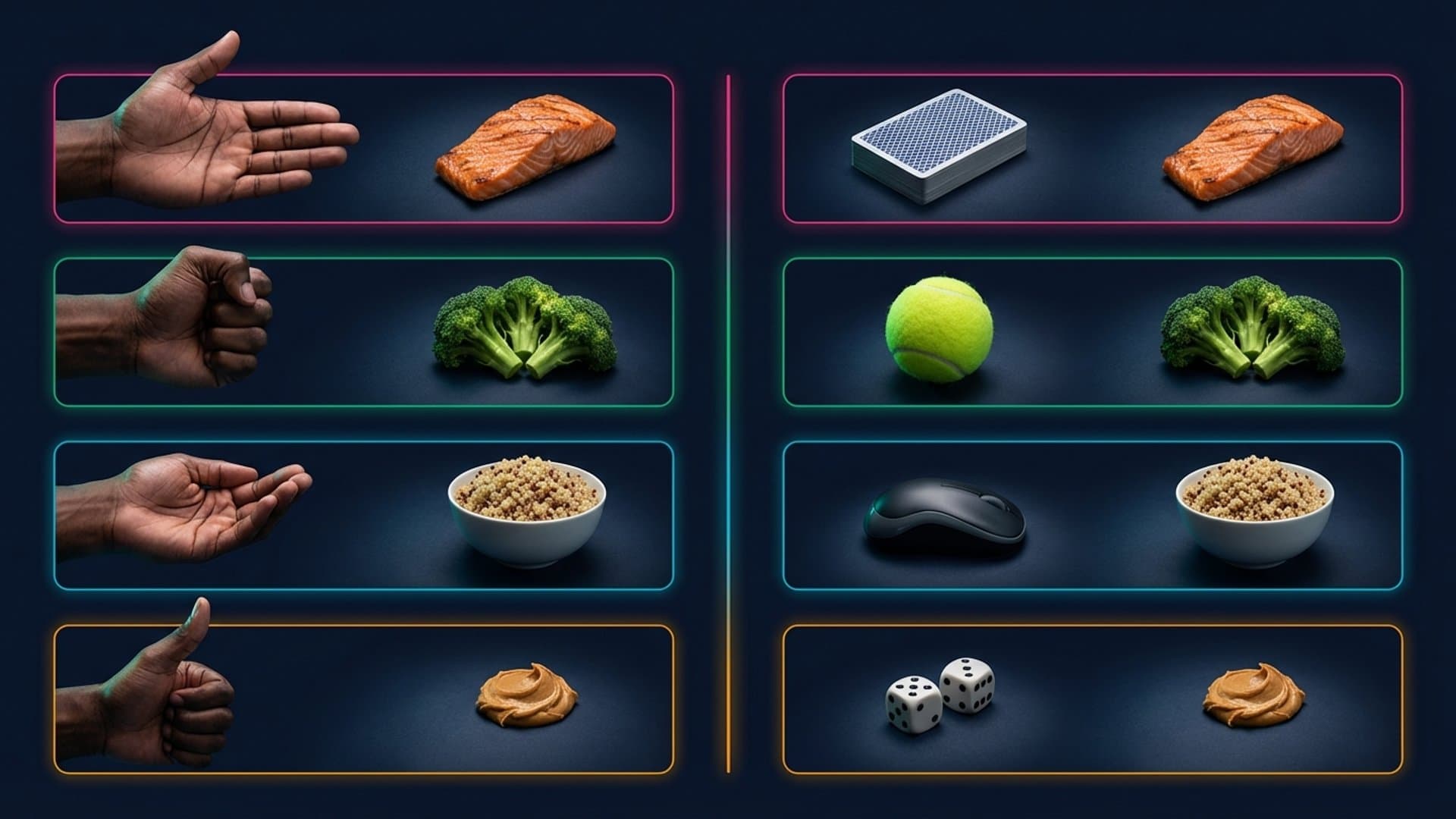
How to Estimate Portions When You Can't Measure
Master visual portion estimation for any situation. From restaurants to buffets to dinner parties, these techniques help you track calories accurately anywhere.

Your First Week of Calorie Tracking: What to Expect
The first week of calorie tracking is slow, noisy, and slightly annoying. Here is how long it actually takes, what the scale will do, and what counts as good enough.
Tracking Fast Food Calories: How to Use the Published Numbers
Fast food is the easiest meal to track accurately, because the numbers are already published. Here's how to read them, where they go wrong, and what to log.